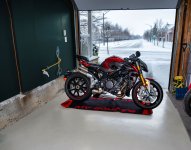







What did you do in your garage today..?

So, what does every new to me bike need?

Farkles.... yes, I know I have a problem....

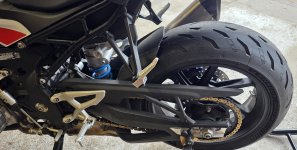
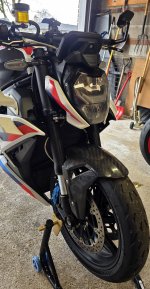
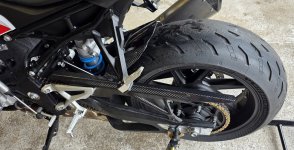
Who wants common plastic fenders?
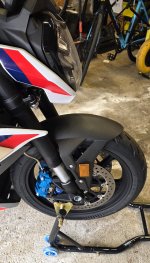
2.jpg

3.jpg


When you could pay a bunch of money for carbon ones that do the same thing...
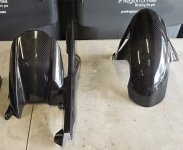
1.jpg

4.jpg

5.jpg

I also have some LighTech wheel adjusters to go on, but apparently I do not have the right socket for the rear wheel. So that is now for another day.
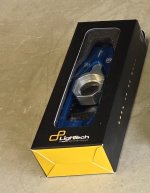
6.jpg
 
I discovered a coolant leak on today's ride. Tired old bike. ZX10R with 156k on it.

I've kinda suspected something's up towards the end of last season ... coolant overflow bottle filling up, sometimes seeing a stream of bubbles inside it ... thinking head gasket leak ... but it sure doesn't run nor act like an engine with a blown head gasket. Yesterday I smelled coolant. This morning I spotted a drop of coolant sitting on one of the coolant pipes. After today's ride - which ended with smelling coolant! - I looked around carefully and shone a flashlight up into the vicinity of the radiator ... and there's visible coolant near the top where one of the upper radiator mounts is attached. The radiator fins were soaked with coolant below this point. Poking around on the forums suggests that it isn't uncommon for the radiator to crack there.

Dammit ... but this is better than dealing with a head gasket.

Seems that aftermarket radiators are fairly readily available. Thinking of buying the aftermarket one ($150ish) and perhaps having the original one repaired if possible. New OEM radiator is available, but $1200+. I'm going to sleep on this. Maybe during the bad weather over the next couple of weeks, I'll take the original one off the bike and see what's up with it.
 
I discovered a coolant leak on today's ride. Tired old bike. ZX10R with 156k on it.

I've kinda suspected something's up towards the end of last season ... coolant overflow bottle filling up, sometimes seeing a stream of bubbles inside it ... thinking head gasket leak ... but it sure doesn't run nor act like an engine with a blown head gasket. Yesterday I smelled coolant. This morning I spotted a drop of coolant sitting on one of the coolant pipes. After today's ride - which ended with smelling coolant! - I looked around carefully and shone a flashlight up into the vicinity of the radiator ... and there's visible coolant near the top where one of the upper radiator mounts is attached. The radiator fins were soaked with coolant below this point. Poking around on the forums suggests that it isn't uncommon for the radiator to crack there.

Dammit ... but this is better than dealing with a head gasket.

Seems that aftermarket radiators are fairly readily available. Thinking of buying the aftermarket one ($150ish) and perhaps having the original one repaired if possible. New OEM radiator is available, but $1200+. I'm going to sleep on this. Maybe during the bad weather over the next couple of weeks, I'll take the original one off the bike and see what's up with it.
If you decide to go with OEM, what about low mileage used rad off ebay?

I did that for an '86 VFR with similar mileage and it worked great.
 
I’m religious with oil changes, particularly on late model pickups because they are all sensitive to dirty oil. I blow out air filters as part of my LOF routine so even on my rougher than normal travels, I’ll go 40k on a good air filter.

I’m not much of a F150 fan and would never have one as a work truck, but ironically my daily is an F150 (fortunately its toughest work is getting coffee). I change oil and filter every 6000km, the old coyote has 250k on her and she has 195-205 psi on all cylinders (like new), and quiet phasers.
Your posts are making me weary of following the service manual for oil changes on my little Mav. Thinking I should do them every 5-8k instead just to be safe.
 
Your posts are making me weary of following the service manual for oil changes on my little Mav. Thinking I should do them every 5-8k instead just to be safe.
6k is my max, I treat Canadian winters as ‘severe duty’.

My F’d150 has 250k on the clock, religious oil changes and it’s tick free, no phaser noise ant tight timing chains on its Coyote. My Jeep Commander 3.7 just crossed 325k same - engine is as tight as new.

Another tip: many modem engines (all Fords, Hemis, and most GM) are very picky about the first number in the oil type. If it says 0w or 5w, never change to 10w.
 
I’ve soldered a couple of ATV rads over the years using low melt aluminum solder. If you land braze - it’s easy and I’ve never had a fail afterward.
 
Yes - our trucks are in a very challenging severe service environment in the far northern reaches of Ontario. Rough clay/mud roads, -30 for months on end. It’s still -5 (as in your pic) some days in early June.

You don’t see many Ford trucks here - if you do they rarely last 3 years - they can’t take the rugged terrain or the cold. We’re lucky to see 50k from an F150, most are dead in 3 years and rarely hit 100k.

It’s Dodge and GM country, Fords come here to die.

The main Ford issues (F and E series) are cold related. Broken door latches are so common we keep a box of spares for 2 trucks - both inside and out. They don’t start reliably below -30 without being plugged in, and they often go into starter lock out from cranking. You can’t heat them up at idle and they idle all day. They don’t produce enough engine heat or oil flow at idle to serve the cam phasers (or warming spots for the crews) that’s the killer. The ABS /Traction control sensors freeze and the trucks go into limp. These are not random problems - they happen to every late model F and E series gas truck that operates here.

Some owners zip tie the gas pedals to keep idle at 1100rpm to build heat and oil flow. Ford has a hidden high idle setting, but it’s got to be enabled in the BCM using a programmer. It’s a PIA to use - every time you stop: enable the parking brake, turn on cruise control, then simultaneous press of the set and resume buttons. Awful when a bunch of guys use the truck because they have to remember the sequence and to turn it on. Awful because F series parking brakes freeze ON in the cold so nobody will touch them. I do an upgrade that bypasses the control part to keeps the high idle always on - it helps, the engines live to 80-100k.

Dodges and GMs live till they rust out or get crashed. Fords tap out early here - 3 years and 50k is all you get from a work truck.

A fleet manager spelled it out clearly for me:
Ford designs F-150s primarily as consumer pickups with work capability, GM and Ram still design theirs primarily as work trucks that consumers buy.
I’m religious with oil changes, particularly on late model pickups because they are all sensitive to dirty oil. I blow out air filters as part of my LOF routine so even on my rougher than normal travels, I’ll go 40k on a good air filter.

I’m not much of a F150 fan and would never have one as a work truck, but ironically my daily is an F150 (fortunately its toughest work is getting coffee). I change oil and filter every 6000km, the old coyote has 250k on her and she has 195-205 psi on all cylinders (like new), and quiet phasers.

I don't have the knowledge of trucks to confirm or refute your statement about Ford vs Chev vs Dodge.
My father did have a '63 Chev with the floor rusted out that would start up and run fine in the worst snowstorms. Just watch out for puddles.
I also have an almost retired contractor friend with 250,000 km on his Ford work truck.
Then there's this poor sod:
 
Back
Top Bottom