






Enough of COVID...what are you doing to the house?

I've seen them go into stucco. Plenty of houses in our neighbourhood have woodpecker holes within their stucco.

Maybe they like the insulation / styrofoam? Can't figure out what else could be in there that would entice them. One house has about 20 holes above their garage.
They like stains and rotting wood. Hope that bugs haven't moved in.
Was it Fruedian that you used a tool flyer to fix a hole , that should be using those tools to fix the wood paneling?
Paper is there in case something was nesting in the hole. It is easier to tear/dig/eat through a sheet of newspaper than a sheet of drywall. If the paper is intact in a couple more days, I'll patch it with tin.

One family helped their neighbours by plugging a hole in the exterior wall that wasps were nesting in. Neighbours came home to a house full of angry hornets.
 
Got a quote to put up a second story at the cottage…100k just for framing (rough price) with me being responsible for getting all the permits and approvals.

That includes second story framing, roof, and enclosing it from the elements.
Dq6ncMWXgAA40nT.jpg
 
Got a quote to put up a second story at the cottage…100k just for framing (rough price) with me being responsible for getting all the permits and approvals.

That includes second story framing, roof, and enclosing it from the elements.
What's happening to Wasaga Beach, house wise? It used to be cottages only but is now a year around home community with most amenities. Which market do you build for, a home or a second (Toy) property? Cottage real estate isn't doing well.

What would the final cost be with windows, electrical, plumbing, finished walls inside and out, trimmed and painted, finished flooring, heating etc? Keep in mind that if it's for yourself upgrading as you go destroys budgets. Then the new addition looks better than the old part so the old part gets a reno.

If the lot value is now $XXX,XXX what would the projected equities be if you added the floor compared to tearing down and building a new house?

I ask because a friend has a fixation on a future inheritance where he gets an uninhabitable house on a premium lot worth ~$1.7 M

He wants to throw a $400 K house on the lot so small bungalow that would sell for $1.8 M, negative ROI. If he had the money he would be better off putting up a $1 M house that would match the rest of the neighbourhood and sell for ~$3 M, positive ROI.
 
At one hundred k for framing , you doing the permits, that guy is making GREAT money .


Sent from my iPhone using GTAMotorcycle.com
100%

I’m not gonna go for it because it’s a ludicrous price IMO for what would add…maybe 500sqft of living space.

The land value is worth more than the house.
 
Spray foam day today. Learned a few things.

The wood has to be below a certain humidity threshold or the foam won’t stick.

The wood can be treated with a stain blocker beforehand (we had that done to cut down on any small rotten areas left over after replacement).

They are putting 5” of foam into the ceiling which will be just about level with the bottom of the ceiling joists. This requires at least two passes. If you don’t do this with a time break in between sprays the foam mixture can heat up enough to cause damage or even a fire and can lose adhesion over time.

That’s a lot of foam. The room will be pretty comfy all year round after this.

After this it’s just drywall and painting and then the roof/room saga is finally done and I can stop paying $100 a month for driveway storage (since last September!) and get back to normal.
 
He wants to throw a $400 K house on the lot so small bungalow that would sell for $1.8 M, negative ROI. If he had the money he would be better off putting up a $1 M house that would match the rest of the neighbourhood and sell for ~$3 M, positive ROI.
While I agree with that math, that lead to a lot of the cottage stupidity. When empty lots exceeded $250K, it made sense to build a $1M house and sell it for >$1.5M. If you build a $250K shack, value would be less than the sum of the parts as the next buyer would likely be tearing it down and building a huge thing. Starter homes or cottages (as opposed to mcmansions on the water) are victims to high land prices.

For your buddy, I would be shocked if it wasn't much cheaper to renovate the "uninhabitable" house than build a crappy new one. That minimizes the money burned to have a dwelling for a few years. Whatever they do on the cheap, the next person will be tearing it down. If they have a 400K budget and live in a 3M neighbourhood, they may find they can't afford to live there anyway as property tax/neighbour complaints will eat them alive.
 
@nobbie48 Wasaga is changing fast (they’re getting a COSTCO!) and there is a lot of new builds.

I’m going to upgrade the house slightly to make it more livable and more modern instead of the wood panelling look.

New drywall, new ceiling drywall, bathroom needs a ton of work as it’s horrible.

I’ll be up there this week to work with an appraiser, measure everything out, learn to draft it in some software.

I’ll frame the basement, insulate the walls, and make some type of space that’s not for living, but isn’t bare walls so at least it can better be used.

I need to upgrade the lights in the basement, recommendations for low ceiling height are appreciated. Panel to be upgraded to 100A breakers from 60A fuses (maybe that should be done before transfer?).

But something needs to be move forward.
 
@nobbie48 Wasaga is changing fast (they’re getting a COSTCO!) and there is a lot of new builds.

I’m going to upgrade the house slightly to make it more livable and more modern instead of the wood panelling look.

New drywall, new ceiling drywall, bathroom needs a ton of work as it’s horrible.

I’ll be up there this week to work with an appraiser, measure everything out, learn to draft it in some software.

I’ll frame the basement, insulate the walls, and make some type of space that’s not for living, but isn’t bare walls so at least it can better be used.

I need to upgrade the lights in the basement, recommendations for low ceiling height are appreciated. Panel to be upgraded to 100A breakers from 60A fuses (maybe that should be done before transfer?).

But something needs to be move forward.
You've already triggered the appraisal, I wouldn't be trying to drive up cost-base now.

Pancake lights work well for basements. Flush with drywall and you aren't restricted on location by joists above. Not my favorite light output (CRI/pattern/etc) but for a basement, good enough. For most of my basement, I replaced the existing boob lights with large (~12") surface pancakes. Given the renovation and really limited height you have, I would recess them to save the 1/2".
 
Last edited:
Personally of all the options you have considered, I’d go up , not addition out ward ,never the basement . But wasaga is the new frontier since collingwood is over the moon and contractors smell Toronto money . If the foundation you have would support the second story , I’d be doing that . Find a better framer , from shelburn or someplace not in cottage land , get the exterior closed in so you can pick away at finishing the space at leisure . Redo the exterior siding on the original cottage so it all looks the same . I’d pull the trigger using pre inheritance money …..


Sent from my iPhone using GTAMotorcycle.com
 
Personally of all the options you have considered, I’d go up , not addition out ward ,never the basement . But wasaga is the new frontier since collingwood is over the moon and contractors smell Toronto money . If the foundation you have would support the second story , I’d be doing that . Find a better framer , from shelburn or someplace not in cottage land , get the exterior closed in so you can pick away at finishing the space at leisure . Redo the exterior siding on the original cottage so it all looks the same . I’d pull the trigger using pre inheritance money …..


Sent from my iPhone using GTAMotorcycle.com
Once all is said and done, we’ll know where we stand financially depending on the final CG tax amount (expecting 50-70k).

Pay that down and then work with what to do next and how our renewal goes. Plan is for HELOC but I’ll reach out to my broker today to get his opinion as well on best route forward.

Any capital upgrades will be well tracked this time around though.

I’m dumb so would even consider doing the framing myself…but not sure that’s actually a viable plan.
 
I’m dumb so would even consider doing the framing myself…but not sure that’s actually a viable plan.
If you're doing that, get a great set of plans. The more detail the better. I'm sure some designers cater to homeowners and include all the standard details you must do to meet code. The few thousand you spend on plans (which you need anyway for permit) can save you many heartaches at inspection time. The big problem with DIY when going up is time. You are removing the existing roof and trying to get it closed in again before everything gets soaked. DIY is much easier when expanding out as you don't care if the new build gets wet.
 
100%

I’m not gonna go for it because it’s a ludicrous price IMO for what would add…maybe 500sqft of living space.

The land value is worth more than the house.
Small areas are more susceptible to parasitic loss from necessities.

If someone pictures 450 square feet it doesn't seem that bad. Then take 45 SF off for the bathroom, 40 SF for interior walls, 25 SF for closets, 20 SF for an entry foyer, kitchen cupboards etc. A staircase is a vertical unusable hallway.
 
Small areas are more susceptible to parasitic loss from necessities.

If someone pictures 450 square feet it doesn't seem that bad. Then take 45 SF off for the bathroom, 40 SF for interior walls, 25 SF for closets, 20 SF for an entry foyer, kitchen cupboards etc. A staircase is a vertical unusable hallway.
"That's a ladder to my storage loft"
"Why are their bedrooms and a bathroom in your storage loft"
"I store kids there"
 
DWV mock-up question for an island sink with a garburator.


I need to offset the drain alignment before tying into the floor drain.


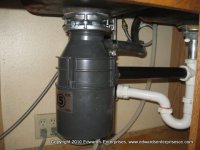
Is it acceptable to cut the garburator discharge elbow to remove the 90° outlet, install a slip-joint connection, and extend the discharge pipe horizontally before dropping into the P-trap?


I found a few references saying this can be done, but I cannot find a straight garburator discharge tube in Canada, so I am not sure if it is accepted.

Basically I would end up with:

kitchen_sink_garbage_disposal_5_0618ca91a0439c2ff1a2eb6c670494c918659d5c.jpg

The other option is to leave the garburator elbow as-is and use two 22.5° elbows on the vertical drop to adjust alignment.

PXL_20260613_184342772.jpg

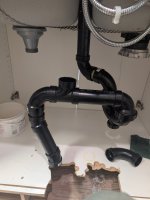
The pipe between the sinks shows where my garburator would be. The yellow paint between the 90s marks where I would like to cut and extend the discharge tube, eliminating the need for the 22.5s on the vertical drop.

Which option is more accepted, and which would drain better?
 
Last edited:
Taking a page out of @mimico_polak life.

FML
Washing machine broke today.
Kenmore (made my LG) showing OE error. Problem with draining water.

Two things in my favour.

1. Parts readily available and inexpensive on amazon and already orderd. Will be here when I will be snoozing away in the middle of the night.
2. I have experience with this as I already performed such repair on my neighbors same model washing machine.

They bought theirs not long after we did (just before Sears went belly up). They are a larger family with more wash loads .
It makes sense with the timing of when their failed and when my failed.

Crappy part is that it is stacked with dryer on top and built-in cabinets. Only access to it from on side.
Almost 2 years to the day.

Drain pump took a dump again.
Looking at my GTAM posts and Amazon history, this exact pump from Amazon failed. The impeller is wobbly and not draining.

I replaced it with the same one from Amazon, as it was easy to order with next day delivery while on the road. I might opt in for the "OEM" or better brand one next time (In 2 years time).

I am tempted to build some sort of dolly platform (on wheels) to move the dryer onto instead of putting it on the floor and picking it back up.
 
DWV mock-up question for an island sink with a garburator.


I need to offset the drain alignment before tying into the floor drain.


Is it acceptable to cut the garburator discharge elbow to remove the 90° outlet, install a slip-joint connection, and extend the discharge pipe horizontally before dropping into the P-trap?


I found a few references saying this can be done, but I cannot find a straight garburator discharge tube in Canada, so I am not sure if it is accepted.

Basically I would end up with:

View attachment 79052

The other option is to leave the garburator elbow as-is and use two 22.5° elbows on the vertical drop to adjust alignment.

View attachment 79053

The pipe between the sinks shows where my garburator would be. The yellow paint between the 90s marks where I would like to cut and extend the discharge tube, eliminating the need for the 22.5s on the vertical drop.

Which option is more accepted, and which would drain better?
The first pic is a correct and typical garburator install, but not typical for an island.

It’s easiest to do this with the garb installed onto the sink basket.

The garb has a 90 designed to connect to a standard 1.5” trap adapter. Next, connect the trap adapter fitting to a short piece of abs1.5” vertically, then add a 90 aimed at the other sink.

The non garb sink will have a trap adapter connected to the sink strainer basket, a vertical 1.5 abs pipe connected to the top of a tee. Use a short piece of abs 1.5” between the 90 on the garb sink and the horizontal tee connection, 3/16 slope toward standard sink.

The vertical part of the ptrap connects to the bottom of the tee with a short piece pipe. The horizontal pipe out of the ptrap connects to the side of another tee with a short piece of pipe. The top of that tee goes to your AAV vent valve (or to a high loop island vent). The bottom goes to your drain.

Question - what’s below? Finished ceiling or no? If it not finished, or accessible, it’s much cleaner to have your ptrap under the floor.
 
The first pic is a correct and typical garburator install, but not typical for an island.

It’s easiest to do this with the garb installed onto the sink basket.

The garb has a 90 designed to connect to a standard 1.5” trap adapter. Next, connect the trap adapter fitting to a short piece of abs1.5” vertically, then add a 90 aimed at the other sink.

The non garb sink will have a trap adapter connected to the sink strainer basket, a vertical 1.5 abs pipe connected to the top of a tee. Use a short piece of abs 1.5” between the 90 on the garb sink and the horizontal tee connection, 3/16 slope toward standard sink.

The vertical part of the ptrap connects to the bottom of the tee with a short piece pipe. The horizontal pipe out of the ptrap connects to the side of another tee with a short piece of pipe. The top of that tee goes to your AAV vent valve (or to a high loop island vent). The bottom goes to your drain.

Question - what’s below? Finished ceiling or no? If it not finished, or accessible, it’s much cleaner to have your ptrap under the floor.

Thanks for the detailed explanation.

I should have clarified that I am switching to a single new sink. The pipe I placed between the two existing sinks shows the approximate location of the new garburator.

Below the island is a tenant suite, so I would much rather avoid putting the P-trap below the floor.

For a single-sink setup with the garburator in that mocked-up location, would you leave the garburator 90 as-is and offset the drain after the vent connection, like in the second picture, or would you extend the garburator discharge before the trap, like in the first picture?
 
Some of the spray foam application has pulled away or shrunk a little from the rafters. Not the whole ceiling but maybe about a quarter of it. The shrinkage isn’t huge, maybe half a cm, but the company is coming back to see what needs doing to rectify it. My concern is that it’s supposed to act as a moisture barrier and the gaps could reach the underside of the old roof and therefore could lead to condensation issues.
 
Almost 2 years to the day.

Drain pump took a dump again.
Looking at my GTAM posts and Amazon history, this exact pump from Amazon failed. The impeller is wobbly and not draining.

I replaced it with the same one from Amazon, as it was easy to order with next day delivery while on the road. I might opt in for the "OEM" or better brand one next time (In 2 years time).

I am tempted to build some sort of dolly platform (on wheels) to move the dryer onto instead of putting it on the floor and picking it back up.

LG had a long run of washers with a poorly designed impeller. The motor has some play on the shaft to help it start, but depending where it stops, it can slap the impeller on startup and fatigue it over time.

The original seems to last about 10 years. My FIL went through three Amazon replacements in two years, so getting two years out of yours is not bad. Mine failed a few months ago, but luckily I had an original spare. On mine, I pull the washer out and jack it backward with the dryer still stacked on top. A friend’s newer LG is improved because the pump can be changed from the front.

I have a 3D model that I am going to try printing in stiff TPU if it fails again. If I start experimenting with it, I will probably cut the frame so I can change it from the front.
 
Back
Top Bottom