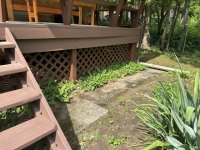
First cut using a zero turn and forgot about the rollbar behind that sticks out wider than the rider. Heat pump is elevated and at shoulder height. It was actually the plastic handles that adjust the rollbar that stick out a couple inches further that caught it. Collection of misfortunes.
4’ is a pretty short span. Remove the existing rim joist the sit your new floor joists on that beam (assume there is another beam tied to the back of the post). then add another beam 4’ out sitting atop posts, use joist hangers on the outbound side. For a short span like that you can go 24OC if the deck boards are 2x.
I’m not crazy about bolting beams to posts (as in the pic), I like them sitting on the posts. I’d add a 2x4 vertical jack block screwed to the 4x4s too.
Benches like the ones in the pic don’t usually pass code (climb and fall hazard). Your deck is at least 42” off the ground so a proper barrier rail is code if that matters to you or your ins company.
4’ is a pretty short span. Remove the existing rim joist the sit your new floor joists on that beam (assume there is another beam tied to the back of the post). then add another beam 4’ out sitting atop posts, use joist hangers on the outbound side. For a short span like that you can go 24OC if the deck boards are 2x.
I’m not crazy about bolting beams to posts (as in the pic), I like them sitting on the posts. I’d add a 2x4 vertical jack block screwed to the 4x4s too.
Benches like the ones in the pic don’t usually pass code (climb and fall hazard). Your deck is at least 42” off the ground so a proper barrier rail is code if that matters to you or your ins company.
I finally got around to laying the floor. I had a few dips to deal with, but overall it has been pretty good.
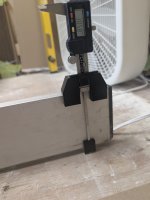
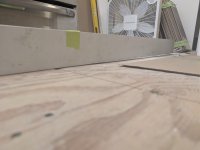
However, I have one area where the floor changes slope. It drops about 10 mm over 1 metre. The flooring allows a maximum dip of 3 mm over 1 metre, but that seems to refer to a low spot that goes down and then back up.
In my case, it is just a smooth change in slope, so there is nothing on the low side to build back up to. Is this likely to be a problem?
I finally got around to laying the floor. I had a few dips to deal with, but overall it has been pretty good.
However, I have one area where the floor changes slope. It drops about 10 mm over 1 metre. The flooring allows a maximum dip of 3 mm over 1 metre, but that seems to refer to a low spot that goes down and then back up.
In my case, it is just a smooth change in slope, so there is nothing on the low side to build back up to. Is this likely to be a problem?
I would hit the crest of the slope with a belt sander. Most floors don't care about level but they do care about being planar. The change in slope is what stresses the joints and may result in joint failure. Lowering the crest and making it wider (eg transition over a 12" wide band instead of a line over a joist) reduces the stress on the finished floor.
When I install hard floors, I work to get the subfloor planar before I start. Most subfloors (and especially OSB) are much higher at the edges than in the field.
I finally got around to laying the floor. I had a few dips to deal with, but overall it has been pretty good.
However, I have one area where the floor changes slope. It drops about 10 mm over 1 metre. The flooring allows a maximum dip of 3 mm over 1 metre, but that seems to refer to a low spot that goes down and then back up.
In my case, it is just a smooth change in slope, so there is nothing on the low side to build back up to. Is this likely to be a problem?
On a room dividing joint that butted up against a different type of flooring height difference my father and I took the weekly advertising flyers and spread them out a bit on the floor to make up the difference..7 years later still good. Probably not recommended in a water prone setting
I finally got around to laying the floor. I had a few dips to deal with, but overall it has been pretty good.
However, I have one area where the floor changes slope. It drops about 10 mm over 1 metre. The flooring allows a maximum dip of 3 mm over 1 metre, but that seems to refer to a low spot that goes down and then back up.
In my case, it is just a smooth change in slope, so there is nothing on the low side to build back up to. Is this likely to be a problem?
Gradual slopes to the wall are not generally a problem with vinyl, so it’s mostly aesthetics. Dip are more problematic as the floor will feel disconnected under foot if the dip is too big.
If it looks off, you’ll need about 5l/m of levelling compound for each m of wall.
Gradual slopes to the wall are not generally a problem with vinyl, so it’s mostly aesthetics. Dip are more problematic as the floor will feel disconnected under foot if the dip is too big.
If it looks off, you’ll need about 5l/m of levelling compound for each m of wall.
When the kids are older and less likely to damage the floor, you can put in something nicer than laminate. Personally, I prefer nail/glue down flooring over floating. Floating almost always sounds like cheap crap in at least one area.
Friends bought a hundred yr old badly framed farmhouse , going from one room to another you could get seasick from the waves .Decision was three steel I beams to span the basement on five posts each so we could bring the house back to level over several months of stretching . Three thirty two ft beams pulled through a basement window with the winch on a 4x4 , jacked into place then setup five adjustable posts . Tighten them up and using a laser level determined we had almost a three in dip in the house . We would adjust over the next yr , monthly ,with beer engineering . So fast forward to later in the day , several pints in ,a brain trust decides let’s really give the first posts some serious tension and speed things along .Tbe living room and dining room were glued down parquet hardwood tiles . About three am the glue started letting go and tiles were jumping about six feet as they blew off the floor . Trying to cross the room to get to the cellar and not get nut sacked with flooring was like a Vietcong minefield . Don’t drink and renovate .
Friends bought a hundred yr old badly framed farmhouse , going from one room to another you could get seasick from the waves .Decision was three steel I beams to span the basement on five posts each so we could bring the house back to level over several months of stretching . Three thirty two ft beams pulled through a basement window with the winch on a 4x4 , jacked into place then setup five adjustable posts . Tighten them up and using a laser level determined we had almost a three in dip in the house . We would adjust over the next yr , monthly ,with beer engineering . So fast forward to later in the day , several pints in ,a brain trust decides let’s really give the first posts some serious tension and speed things along .Tbe living room and dining room were glued down parquet hardwood tiles . About three am the glue started letting go and tiles were jumping about six feet as they blew off the floor . Trying to cross the room to get to the cellar and not get nut sacked with flooring was like a Vietcong minefield . Don’t drink and renovate .
Lol reminds me of when we were jacking up a house like that that someone removed the posts in the basement for more room the center was sagged 4 inches. One of the jack posts broke during jacking and the 2 upper floors came down about 2 inches. The guy who was working in the attic almost pooped himself and came running out the door.
Lol reminds me of when we were jacking up a house like that that someone removed the posts in the basement for more room the center was sagged 4 inches. One of the jack posts broke during jacking and the 2 upper floors came down about 2 inches. The guy who was working in the attic almost pooped himself and came running out the door.
Why was there even a guy there during the lift? Was it hard to do? Who did it for you?
I originally rejected the idea of lifting the cottage...but now am considering it again to lift for a full height basement.
Dad told me he always wanted to extend the house out 10ft but sadly I think that will be stupidly expensive, and more importantly beyond a DIY scope for my skills. But I'd love to take on that type of challenge.
Why was there even a guy there during the lift? Was it hard to do? Who did it for you?
I originally rejected the idea of lifting the cottage...but now am considering it again to lift for a full height basement.
Dad told me he always wanted to extend the house out 10ft but sadly I think that will be stupidly expensive, and more importantly beyond a DIY scope for my skills. But I'd love to take on that type of challenge.
I’m using 60" x 9" laminate. My subfloor is 5/16" plywood, not OSB. The drop is very gradual and runs along the length of the room, roughly through the middle. I suspect it’s because the joists start framing into the stairwell there instead of continuing to the exterior wall. There’s no crest or hump to sand down, just a change in slope. I guess I could feather the transition out farther.
For the occasional dips, I’ve been using 30# roofing felt, 1/8" hardboard, and 1/4" plywood. I haven’t needed the 1/4" yet. I looked at some self-levelers, but the ones I found need metal lath over plywood. What leveling compound should I use to extend the slope?
Friends bought a hundred yr old badly framed farmhouse , going from one room to another you could get seasick from the waves .Decision was three steel I beams to span the basement on five posts each so we could bring the house back to level over several months of stretching . Three thirty two ft beams pulled through a basement window with the winch on a 4x4 , jacked into place then setup five adjustable posts . Tighten them up and using a laser level determined we had almost a three in dip in the house . We would adjust over the next yr , monthly ,with beer engineering . So fast forward to later in the day , several pints in ,a brain trust decides let’s really give the first posts some serious tension and speed things along .Tbe living room and dining room were glued down parquet hardwood tiles . About three am the glue started letting go and tiles were jumping about six feet as they blew off the floor . Trying to cross the room to get to the cellar and not get nut sacked with flooring was like a Vietcong minefield . Don’t drink and renovate .
I’m using 60" x 9" laminate. My subfloor is 5/16" plywood, not OSB. The drop is very gradual and runs along the length of the room, roughly through the middle. I suspect it’s because the joists start framing into the stairwell there instead of continuing to the exterior wall. There’s no crest or hump to sand down, just a change in slope. I guess I could feather the transition out farther.
For the occasional dips, I’ve been using 30# roofing felt, 1/8" hardboard, and 1/4" plywood. I haven’t needed the 1/4" yet. I looked at some self-levelers, but the ones I found need metal lath over plywood. What leveling compound should I use to extend the slope?
Just in case it helps. There’s a kit you can buy after an install that is an injector and a special compound that fills gaps under laminate boards. It’s an elastomer so the floor still floats. You do have to drill a small hole but you can plug that afterwards.
This site uses cookies to help personalise content, tailor your experience and to keep you logged in if you register.
By continuing to use this site, you are consenting to our use of cookies.