






Enough of COVID...what are you doing to the house?

Thanks for the detailed explanation.

I should have clarified that I am switching to a single new sink. The pipe I placed between the two existing sinks shows the approximate location of the new garburator.

Below the island is a tenant suite, so I would much rather avoid putting the P-trap below the floor.

For a single-sink setup with the garburator in that mocked-up location, would you leave the garburator 90 as-is and offset the drain after the vent connection, like in the second picture, or would you extend the garburator discharge before the trap, like in the first picture?
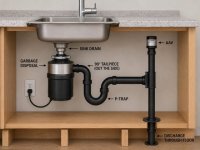
Simpler! Connect trap adapter to the 90 out of the garby, then a short piece of abs into your ptrap. Connect the horizontal arm of the ptrap to a to a tee, the AAV to the top of the tee, the drain to the bottom. .

The pic below shows the connections, you probably have a slightly different 90 out of the gsrburator - likely retained with a plate and sealed with a gasket.

You can swivel the garby, the swivel point in the ptrap and adjust the length of the horizontal trap arm to get a straight shot to the existing drain - no 45s should be required.
1781398530148.jpeg
 
Last edited:
Simpler! Connect trap adapter to the 90 out of the garby, then a short piece of abs into your ptrap. Connect the horizontal arm of the ptrap to a to a tee, the AAV to the top of the tee, the drain to the bottom. .

The pic below shows the connections, you probably have a slightly different 90 out of the gsrburator - likely retained with a plate and sealed with a gasket.

You can swivel the garby, the swivel point in the ptrap and adjust the length of the horizontal trap arm to get a straight shot to the existing drain - no 45s should be required.

View attachment 79056

Yes, that is basically what I have.
The issue is that the joist with the main drain is much closer to the garburator. Even if I rotate the garburator away, and the P-trap back toward the main drain, once I include the required 3" after the p-trap before the AAV, the drop ends up past the main drain location.
That is why I need to either extend the garburator discharge pipe to take it back further, or add the offset in the vertical drop.
 
Yes, that is basically what I have.
The issue is that the joist with the main drain is much closer to the garburator. Even if I rotate the garburator away, and the P-trap back toward the main drain, once I include the required 3" after the p-trap before the AAV, the drop ends up past the main drain location.
That is why I need to either extend the garburator discharge pipe to take it back further, or add the offset in the vertical drop.
Take a look at the pic again. The aav goes on top of the tee. The trap arm can be longer than 3”, that’s the minimum. You should be able to hit anywhere with a straight shot rotating the garby and trap swivel point.

You might need 2x 45s to get the AAV up high beside or behind the sink.

You can also rotate the 90 out of the sink then add another 90 to turn it down after the trap adapter.
 
Most cities prohibit them. Daught is on the west coast, no idea about rules there. In any case, there is zero enforcement. Most RE listings identify garburators. It would be trivial to mine listings and send compliance notices.
For residential use in the GTA:

Toronto, Peel — Allowed
York Region, Halton — allowed but discouraged
Durham — prohibited

.
 
Most cities prohibit them. Daught is on the west coast, no idea about rules there. In any case, there is zero enforcement. Most RE listings identify garburators. It would be trivial to mine listings and send compliance notices.
Why are they not allowed?
 
Any recommendations on free software for home layouts?

Mapped out full cottage on paper but would like to transfer it to a 3D layout.
 
Any recommendations on free software for home layouts?

Mapped out full cottage on paper but would like to transfer it to a 3D layout.
I tried a bunch of options. What I wanted was the ability to keep adding to a line as I measured around the space. I ended up using FreeCAD. Steep learning curve, but totally worth it.

When I went to IKEA to order the kitchen, I could answer every measurement question. If I need to cut an access hole to reach something above, I can measure from a wall below and know where I am.

I had some FreeCAD experience from 3D printing, so I was not starting from zero. Blender can work too. This tutorial is good:

It is the geeky, harder way to do it, but the free online options all annoyed me.

Take a look at the pic again. The aav goes on top of the tee. The trap arm can be longer than 3”, that’s the minimum. You should be able to hit anywhere with a straight shot rotating the garby and trap swivel point.

You might need 2x 45s to get the AAV up high beside or behind the sink.

You can also rotate the 90 out of the sink then add another 90 to turn it down after the trap adapter.

All great points, thanks. That should work then.

I was worried I might run into swivel or angle limits, especially since IKEA does not show the exact drain location in the sink dimensions. I am working with a few guesstimates.

Yep I'm in Squamish. Garbs are pretty much in every home. They are great for getting rid of oil filters 😈
 
I tried a bunch of options. What I wanted was the ability to keep adding to a line as I measured around the space. I ended up using FreeCAD. Steep learning curve, but totally worth it.

When I went to IKEA to order the kitchen, I could answer every measurement question. If I need to cut an access hole to reach something above, I can measure from a wall below and know where I am.

I had some FreeCAD experience from 3D printing, so I was not starting from zero. Blender can work too. This tutorial is good:

It is the geeky, harder way to do it, but the free online options all annoyed me.


All great points, thanks. That should work then.

I was worried I might run into swivel or angle limits, especially since IKEA does not show the exact drain location in the sink dimensions. I am working with a few guesstimates.

Yep I'm in Squamish. Garbs are pretty much in every home. They are great for getting rid of oil filters 😈
Thanks!

Sadly my Surface Pro 3 isn't able to run Blender due to graphics card issues.

I've got SketchUp here on the laptop so will try that or other options.
 
Gords Basement Waterproofing. I have used them a couple of times and worked out well.

 
Anyone have a reference for a waterproofing company? Dad found water spots on the wall today and water pooling underneath.
Is the basement finished?
How bad are the cracks?

There are DIY kits available.
 
Question for the brain trust.

Cottage is approx 700sqft +/- with gas furnace and is year round. Looking to get air conditioning into it as some weekends it's unbearably hot in there.

Mini-split or traditional air conditioner?

Currently have a 10,000BTU window AC that I'll be installing, but thinking long term not sure which way is the route to go.

I prefer DIY wherever possible...but AC installation may not be one of those things.
 
There is a diy mini split on market , but it’s for one room essentially, either bedroom doors stay open or you cook . If you have a forced air furnace that probably the ticket . It’s likely a six grand problem.


Sent from my iPhone using GTAMotorcycle.com
 
There is a diy mini split on market , but it’s for one room essentially, either bedroom doors stay open or you cook . If you have a forced air furnace that probably the ticket . It’s likely a six grand problem.


Sent from my iPhone using GTAMotorcycle.com
Good to know there's DIY options. I thought they needed an HVAC tech 100% for any charging of the system.

Will look into it.

The cottage does have ducting, but no AC. We had one in the basement for many years but ended up throwing it out as it was for the old freon (R134?) that is no longer legal so we tossed it.

Second question:

Currently have a LARGE 10" Bosch Table Saw with gravity stand. It's great for what it is...but too big and heavy for normal use.

Recommendations for a smaller portable one? I very rarely need to cut 4x8 plywood sheets (which is a pain with the Bosch, but will need something smaller for the cottage when we start up there.
 
Question for the brain trust.

Cottage is approx 700sqft +/- with gas furnace and is year round. Looking to get air conditioning into it as some weekends it's unbearably hot in there.

Mini-split or traditional air conditioner?

Currently have a 10,000BTU window AC that I'll be installing, but thinking long term not sure which way is the route to go.

I prefer DIY wherever possible...but AC installation may not be one of those things.
In small houses I use mini splits. If you already have forced air, it’s a simple install.

Size it for the whole house. Put the head unit in the largest room.

Restrict the return vents by 75% in the room with the head unit, run your forced air furnace fan only. The furnace will create negative pressure in the other rooms, that causes circulation thru the whole house.

I’m doing one this summer in my little 2br house in Timmins (1000sq’). I don’t have forced air ducting so we’re putting small bathroom type exhaust fans in the 2bedrooms, they suck hot from the ceiling and dump it back into the open area living room /kitchen where the mini split unit sits.

Senville.com are economical and offer good DIY support.
 
Last edited:
Back
Top Bottom