







Enough of COVID...what are you doing to the house?

Good to know there's DIY options. I thought they needed an HVAC tech 100% for any charging of the system.

Will look into it.

The cottage does have ducting, but no AC. We had one in the basement for many years but ended up throwing it out as it was for the old freon (R134?) that is no longer legal so we tossed it.

Second question:

Currently have a LARGE 10" Bosch Table Saw with gravity stand. It's great for what it is...but too big and heavy for normal use.

Recommendations for a smaller portable one? I very rarely need to cut 4x8 plywood sheets (which is a pain with the Bosch, but will need something smaller for the cottage when we start up there.
Ducting for A/C is larger than ducting for heat only. I don't know what the cottage ductwork was designed for. While is it common in the US, it is rare here to have a mini-split with a coil in ductwork. If you could find one here, a coil in the ductwork and head in the living room would probably work well as that lowers the load and airflow required for the ductwork.

For portable table saws, I like Dewalt as their rack and pinion fence is quite accurate. I don't know about weight compared to the Bosch but I carry it down a ladder from storage. Your gravity Stand is handy but very heavy.
 
Ducting for A/C is larger than ducting for heat only. I don't know what the cottage ductwork was designed for. While is it common in the US, it is rare here to have a mini-split with a coil in ductwork. If you could find one here, a coil in the ductwork and head in the living room would probably work well as that lowers the load and airflow required for the ductwork.

For portable table saws, I like Dewalt as their rack and pinion fence is quite accurate. I don't know about weight compared to the Bosch but I carry it down a ladder from storage. Your gravity Stand is handy but very heavy.
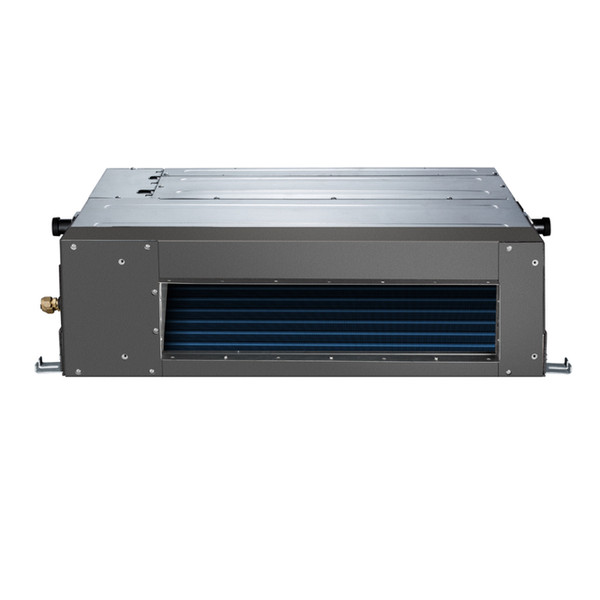
You can get ducted air handlers for small houses. They don’t mount into the furnace but will deliver decent flow to a few rooms. If you get a 2 zone mini, put one come in the biggest common area, then the air handler in the attic for three bedrooms. Or Cold air falls, so the basement will stay cool.

 
Last edited:
You can get ducted air handlers for small houses. They don’t mount into the furnace but will deliver decent flow to 2-3 rooms. If you get a 2 zone mini, put one come in the biggest common area, then the air handler in the attic for three bedrooms. Cold air falls, so the basement will stay cool.

In his case, basement is atypical. No passage between main floor and basement without going outside. The ductwork does have vents into the basement but no intentional returns (just unsealed connections that probably work). Cycling fan may be sufficient but in that cottage, gravity alone won't help the basement.
 
In his case, basement is atypical. No passage between main floor and basement without going outside. The ductwork does have vents into the basement but no intentional returns (just unsealed connections that probably work). Cycling fan may be sufficient but in that cottage, gravity alone won't help the basement.
Floor grate would do the trick.
 
You can get ducted air handlers for small houses. They don’t mount into the furnace but will deliver decent flow to a few rooms. If you get a 2 zone mini, put one come in the biggest common area, then the air handler in the attic for three bedrooms. Or Cold air falls, so the basement will stay cool.

Wow never even knew this existed….need to look further into this.
 
Good to know there's DIY options. I thought they needed an HVAC tech 100% for any charging of the system.

Will look into it.

The cottage does have ducting, but no AC. We had one in the basement for many years but ended up throwing it out as it was for the old freon (R134?) that is no longer legal so we tossed it.

Second question:

Currently have a LARGE 10" Bosch Table Saw with gravity stand. It's great for what it is...but too big and heavy for normal use.

Recommendations for a smaller portable one? I very rarely need to cut 4x8 plywood sheets (which is a pain with the Bosch, but will need something smaller for the cottage when we start up there.

Not any more. Many mini splits come in kits with pre-charged lines now. As for coverage, the kits are getting cheap enough that you can install multiple units and come out ahead.


24k BTU and $1400.

You need space on your breaker panel for these. The better units are 220V but if you go lower BTU you can get 110v. If you need circuit space you can do a pony panel.

If you want the full warranty then these things are supposed to be professionally installed but at $1400 if it lasts a few years you can just replace it and likely come out ahead of a central AC unit.

Bonus…they can heat the place too.

Our mini split that was installed last year is great. Very glad we went this route.
 
Not any more. Many mini splits come in kits with pre-charged lines now. As for coverage, the kits are getting cheap enough that you can install multiple units and come out ahead.


24k BTU and $1400.

You need space on your breaker panel for these. The better units are 220V but if you go lower BTU you can get 110v. If you need circuit space you can do a pony panel.

If you want the full warranty then these things are supposed to be professionally installed but at $1400 if it lasts a few years you can just replace it and likely come out ahead of a central AC unit.

Bonus…they can heat the place too.

Our mini split that was installed last year is great. Very glad we went this route.
That's awesome thank you!

First thing that will be installed at the cottage is a new 100A panel as the 60A isn't enough for the cottage as is. I have the panel, just need to find the time and talk to a good GTAMer here about installation and when it can be done (and for how much).

I know where I want it, what I want, and just a matter of getting the thing moving.

I also don't want to overwhelm myself but the order will start with panel, then joist rim insulation. The lights on the main floor need to be upgraded, but that's not an urgent need (probably some fan LED units to help move air).

Basement will be with 1" rigid insulation, then framing, and another 1" in b/w the studs for an R10 value. Debating on laying it all over the floor or just use the bubble that @Scuba Steve mentioned many pages ago, with flooring directly above it. Basement ceiling height is an issue, so don't want to reduce it much more than I really have to.
 
That's awesome thank you!

First thing that will be installed at the cottage is a new 100A panel as the 60A isn't enough for the cottage as is. I have the panel, just need to find the time and talk to a good GTAMer here about installation and when it can be done (and for how much).

I know where I want it, what I want, and just a matter of getting the thing moving.

I also don't want to overwhelm myself but the order will start with panel, then joist rim insulation. The lights on the main floor need to be upgraded, but that's not an urgent need (probably some fan LED units to help move air).

Basement will be with 1" rigid insulation, then framing, and another 1" in b/w the studs for an R10 value. Debating on laying it all over the floor or just use the bubble that @Scuba Steve mentioned many pages ago, with flooring directly above it. Basement ceiling height is an issue, so don't want to reduce it much more than I really have to.

If you don’t need to cut any of the lines (people just loop the excess if doing a self install) then the process is cut a small hole (it’s smaller than you think) to run the lines from the head unit. Install the head unit and run the lines outside. Install the condenser unit either on a stand or a shelf attached to the wall. Connect the lines. Run a weatherproof electrical cut off fuse box (that’s code I believe) from the panel and run the power from that to the condenser unit.

Extras are the shelf/stand, electrical supplies and shroud for the lines (which are weirdly expensive). You don’t necessarily need the shroud but it makes things look neat. It’s an extra few hundred bucks.

We paid to have our unit installed and they were a great company to deal with and I got a name brand high end unit but if I was doing it again I think I would pay an electrician to do the electrical work and connect up one of the cheaper units. Once the fuse panel and connections are there you can just remove and replace whenever you like.

People do this all day every day in tropical countries and have done for years such that an install costs very little. The HVAC industry here have mostly steered everyone away or charge an arm and a leg for the things.
 
Arm and leg is correct , we needed a new A/C unit and had a quote from the company that installed the furnace a yr earlier . It was a fail in January so we decided we would do AC later . Friend I would not have considered asking, offered one picked up at the Canadian distribution center , he had a name for the guy that would install . Total project was several thousand less than my local installer needed .
Everybody need to eat but an $1,100 AC unit becomes $4,595. on sale?
 
There is some rule in the HVAC world about $5000 or something then they are interested in replacing it / doing the work.
Plus there probably some rigging of gov rebates where they jack up the prices just enough.
 
For mini-splits they sell DIY ones like Mr Cool with charged lines but the non-DIY ones the unit is charged you need to vacuum the lines etc...

Even though the cottage has heat if for whatever reason that source is not working a heat pump system can be a backup in winter until the temps get too low for it to work.
 
Last edited:
Good to know there's DIY options. I thought they needed an HVAC tech 100% for any charging of the system.

Will look into it.

The cottage does have ducting, but no AC. We had one in the basement for many years but ended up throwing it out as it was for the old freon (R134?) that is no longer legal so we tossed it.

Second question:

Currently have a LARGE 10" Bosch Table Saw with gravity stand. It's great for what it is...but too big and heavy for normal use.

Recommendations for a smaller portable one? I very rarely need to cut 4x8 plywood sheets (which is a pain with the Bosch, but will need something smaller for the cottage when we start up there.
I use a tracksaw (poor man's Kreg one that uses a circular saw) for most stuff now instead of hauling out the table saw. Table saw comes out just when it is really needed or if something is more or a production like scenario (many multiple identical cuts).

It is also way better to break down 4X8 sheets than manhandling them on the table saw.
 
For mini-splits they sell DIY ones like Mr Cool with charged lines but the non-DIY ones the unit is charged you need to vacuum the lines etc...

Even though the cottage has heat if for whatever reason that source is not working a heat pump system can be a backup in winter until the temps get too low for it to work.

This is a big bonus. I didn’t expect the heat pump on my mini split to work as well as it did this winter. Our bedroom over an unheated garage was more comfortable than it’s ever been.

It needs repeating that you can buy 3 or more of these self install units for the price of a dealer installed one or even more if comparing to a central AC unit. The tide is changing, there’s a reason why these things are everywhere outside North America.

Edit: I forgot to add….these are way more efficient and economical than a central unit too. You’re not losing energy in expansive ductwork. My main furnace did a lot less work this past winter.
 
You can get a multi-head unit fairly cheap, pre-charged. Last year, my proposal for the strata to allow them failed by one vote. People think they are noisy clunkers, when in reality they are very quiet. I really wish someone made a unit that goes in the attic and pulls and dumps air through the soffit. The other concern is power demand. If you replace the baseboards or interlock with them, there is no extra load.


Now that I have my master’s, I’m going to be doing a lot of these, especially in apartment buildings. I’m also working on building a smart thermostat that interlocks baseboards.


Now back to my project. Is it a bad idea to put down the SonopanX, then plywood on top, and then build the cabinet frame? Or should I put the frame on the subfloor and fill the frame with SonopanX?
 
Last edited:
Back
Top Bottom




