
Not saying it is right or wrong... but my neighbours built a very, very large deck over their old patio about a decade ago. Not how I would do it but... They used 2X6 joists/framing. They cut 4x4 posts up (say 6.5 inches) and just sat them on the old patio and bolted the deck framing to them with the framing an inch (give or take) off ground for "drainage". With decking and space below the 2X6 framing they are about 7.5 inches from ground level to surface. So far, no serious issues...







You are using an out of date browser. It may not display this or other websites correctly.
You should upgrade or use an alternative browser.
You should upgrade or use an alternative browser.
Enough of COVID...what are you doing to the house?
- Thread starter mimico_polak
- Start date
Considering your clearance is only 4"...then even a 2x4 would be tough as that allows for a 3.5" clearance.
I'd find some way to mount it to the pavers and just run off those.
Ahhh…looks like I can do something similar to this….plus I could even try to screw a few sleepers into the pavers. It’s going to be a fair bit of shimming but should work.

How to Build a Deck Over a Concrete Patio
The ultimate solution for a hopeless slab.
 www.familyhandyman.com
2x4 x12 for sleepers and then I could use 5/4 deck boards. I have a bunch of shingles for shims from the roof.


PEX is so simple to use it’s crazy . My advice in an outbuilding ( unheated ) design your runs so you have low points to drain it out in the winter . Our off grid place had an air line hookup in line so the pipes could be blown out for winter . A barn would be simpler
Sent from my iPhone using GTAMotorcycle.com
Sent from my iPhone using GTAMotorcycle.com
@JC do not use your old shingles for shims , it’s just hillbilly engineering . I’d use two x six for sleepers , they lay flatter and span nicer and twist less than two x four . Then use your five/quarter deck boards and you’re good to go . You probably don’t need to screw into pavers , gravity will hold it down. I like to use wooden shims and some construction adhesive so when I stick them in , done , they don’t move .
Sent from my iPhone using GTAMotorcycle.com
Sent from my iPhone using GTAMotorcycle.com

Mad Mike
Well-known member
It would have been simpler to do a straight intersection, any carpenter could handle that.Not sure. I trusted the guys that came up with the drawings and the engineers to do it right but I know what you mean. If you look at the extension lines of the roof to do it that way it would be a bit more complex than what has been done though. I know there were issues with the relative heights and slope and intersections of the two roof sections which is why we needed the architects and engineers to weigh in. They needed enough slope to shed snow or something and that has roof height implications and thus tie in method issues. The whacky angles everywhere also didn’t help.
This is a million times better than what was there before. The city are coming to inspect it soon so they will need to sign off on it too.
For on grade decks, there are a few options, the simplest is sleepers 24”oc. A sleeper is basically a square timber ground contact pressure treated 4x4 laying on level ground, or a 2x4 on its side over 2” eps laying on the ground or across level patio stones or pavers. For both options, you need 2x6 decking for the 24” span and to counteract warp and twist on the sleepers.Next project. I’d like to build a ground level deck that has an uneven shape with a few different angles etc over a set of uneven pavers. The problem is that I can only really have this deck just under 4” in overall height as there’s a door threshold that I need to tie in to. How can I frame the deck if I’m going to use normal 2” deck boards for the surface? Can I use those deck boards flat side down for the frame too giving me my required height? If I do how do I get any rigidity in that frame?
This isn’t a huge deck, 140” x 160” is the largest dimension.
I don’t really want to pull up the pavers if I don’t have to. They are a nice solid base and weed control plus they are heavy suckers.
Edit: I’m a dumbass, I can make this a lot cheaper if I can use 2x2 pressure treated for the frame and 5/4” deck boards. Would that work?
Edit 2. 2x2 is a bad idea for framing it seems.
If it was me, I’d lift call a guy to and level the pavers- done right that’s a 20 year maintenance free deck.
Mad Mike
Well-known member
That’s not uncommon. Not all ground heaves, if it’s well drained it shouldn’t move.Not saying it is right or wrong... but my neighbours built a very, very large deck over their old patio about a decade ago. Not how I would do it but... They used 2X6 joists/framing. They cut 4x4 posts up (say 6.5 inches) and just sat them on the old patio and bolted the deck framing to them with the framing an inch (give or take) off ground for "drainage". With decking and space below the 2X6 framing they are about 7.5 inches from ground level to surface. So far, no serious issues...
We just did a 60x10 deck on the front of a sixplex. Our footings? 6” compacted gravel, 2 ply’s of eps 6’x6’, 2 ply’s of 2x10 x20” then 8x8 posts on top.
I’m also with @mike on this paving stone patio , I’d hire a company to come in , lift the stones and level . Then it’s there for twenty + yrs . You haven’t spent a grand or more on crappy PT lumber , and it’s done .
Sent from my iPhone using GTAMotorcycle.com
The pavers look like crap though that’s the issue. I’ve built decks in other parts of the garden and they look great but they had more clearance than I have for this one and not built one on sleepers before.
I’ve thought about just pulling up the pavers and pouring a concrete pad too but that wouldn’t look as nice as a wooden deck for this area.
I priced up the materials for this area and it comes to about $400 in lumber and screws so may just go ahead and try it. Worst case scenario is it’s crap and I pull it up and have a bunch of lumber for another project somewhere else. I may not be the best carpenter out there but I also like working with wood more than stone/concrete etc.
I have a fancy idea about building in a little water feature in the area which would look better built into a deck.

daught
Well-known member
I just did around 50 connections moving water lines from one wall to another, so I am basically an expert nowAnyone have experience with PEX. I'd like to tackle the hillbilly plumbing in my barn but would appreciate a second set of eyes.

My main takeaway for crimped copper ring PEX:
Expansion is nice, but the tools are more expensive.
At minimum, get the offset head if you are working in tight spaces. The crimp tool takes up a lot of room, and you need to be perfectly aligned.
Give the rings a light squeeze with Channellocks to set them in place before crimping.
I also made a 3D printable marking tool that I will post on GitHub at some point. If anyone needs it sooner, I can send the OpenSCAD file. It is really handy for quickly marking the lower and upper crimp limits so you are not second guessing whether it landed in the right spot.

I bought the basic crimp tool from princess auto and a tube cutter , I think all in it was under sixty bucks , bag of copper crimp rings and I was in business . I do try to be really careful and keep cuts square and line things up cleanly. Total cost was like paying for twenty mins of a real plumbers time .
Sent from my iPhone using GTAMotorcycle.com
Sent from my iPhone using GTAMotorcycle.com
Mad Mike
Well-known member
I install pex by the mile! I only use A, and if you’re in a space that can freeze, that’s your best option.Anyone have experience with PEX. I'd like to tackle the hillbilly plumbing in my barn but would appreciate a second set of eyes.
Tell me what you’re planning and I might be able to help design and install. I brought my expansion tools home this trip.
Mad Mike
Well-known member
If you’re going Pex B, i always suggest using the stainless cinch rings. The tool gets into tighter spaces and using it is a little more DIY friendly.I bought the basic crimp tool from princess auto and a tube cutter , I think all in it was under sixty bucks , bag of copper crimp rings and I was in business . I do try to be really careful and keep cuts square and line things up cleanly. Total cost was like paying for twenty mins of a real plumbers time .
Sent from my iPhone using GTAMotorcycle.com
daught
Well-known member
Why do you recommend SS rings over copper?If you’re going Pex B, i always suggest using the stainless cinch rings. The tool gets into tighter spaces and using it is a little more DIY friendly.
Has anyone used the sonopanx under flooring? It has better specs for sound insulation. Are their products hype or worth it? I'd really like to reduce walking noise transmission between floors.

The SS rings are clips that are closed by something that looks like nippers. The tool is much smaller and easier to get in places.Why do you recommend SS rings over copper?
Has anyone used the sonopanx under flooring? It has better specs for sound insulation. Are their products hype or worth it? I'd really like to reduce walking noise transmission between floors.
Sonopan may help or it may be mostly a waste. A lot depends on the entire construction (eg laminate/sonopan/ 5/8 OSB/2x12 joist/fibreglass drop ceiling). Post the entire construction planned.
Mad Mike
Well-known member
The ss cinch ring tool is easier to use and gets into tighter spaces. Also, one ss cinch tools works with all sizes of rings/pipes - most homes have 1/2 and 3/4” pipe.Why do you recommend SS rings over copper?
Acoustic underlays dampen impact noise (footsteps), they don’t provide a lot of sound insulation (tv, music, shouting).Has anyone used the sonopanx under flooring? It has better specs for sound insulation. Are their products hype or worth it? I'd really like to reduce walking noise transmission between floors.
Works best when installed under click vinyl or wood floors, not as effective under tile or laminate, and does virtually nothing under carpet.
Last edited:
daught
Well-known member
I thought you were suggesting stainless crimp rings, not cinch rings. Apparently stainless crimp rings reduce the PEX warranty to 10 years. Not sure about cinch rings.
The main problem I am trying to solve is my wife’s heel strike when walking. It drives me nuts, and I am sure it bothers my tenants too. It sounds like she is dragging a jack with square wheels behind her. It is a sensitive subject because she has had a lot of knee surgeries and issues.
Floor assembly:
Planning to install click laminate, Fuzion Nautiq Pro.
Previously had builder grade closed cell foam underlay. Quote is for something similar, Big Blue closed cell foam.
5/8 inch T&G plywood.
Spotty fiberglass insulation. Where I cut and lifted the subfloor, the insulation was there but poorly placed with lots of gaps
5/8 inch drywall ceiling below
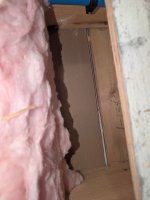
One big issue is that the insulation gap is close to where the ceiling and downstairs wall meet. It is basically just a taped joint there.
I assume the best solution is lifting all the subfloor, but that is more than I want to take on for this project. Any ideas on:
The main problem I am trying to solve is my wife’s heel strike when walking. It drives me nuts, and I am sure it bothers my tenants too. It sounds like she is dragging a jack with square wheels behind her. It is a sensitive subject because she has had a lot of knee surgeries and issues.
Floor assembly:
Planning to install click laminate, Fuzion Nautiq Pro.
Previously had builder grade closed cell foam underlay. Quote is for something similar, Big Blue closed cell foam.
5/8 inch T&G plywood.
Spotty fiberglass insulation. Where I cut and lifted the subfloor, the insulation was there but poorly placed with lots of gaps
5/8 inch drywall ceiling below
One big issue is that the insulation gap is close to where the ceiling and downstairs wall meet. It is basically just a taped joint there.
I assume the best solution is lifting all the subfloor, but that is more than I want to take on for this project. Any ideas on:
- How to deal with the ceiling to wall joint?
- How to fix the insulation gaps? Blown in, or is lifting the subfloor the only real option?
- Whether a better underlay like SonopanX would help, and why it would not under click laminate?
You might get 10 dB improvement at best (impact sounds half as loud). Resilient channels above the drywall would be cheaper with a bigger improvement but obviously that would suck to do with tenants already there. I'd probably go with QT4010 if I was doing it on top and didn't have much height. Sonopanx or QT will both be better than the thin foam crap they pretend is IIC70. For footfalls, weight and deflection are your friends. If you want to make a huge difference, float Gypcrete over a resilient layer and it will be magically better but it will cost you a few inches and most people are unwilling/unable to give up that much height.I thought you were suggesting stainless crimp rings, not cinch rings. Apparently stainless crimp rings reduce the PEX warranty to 10 years. Not sure about cinch rings.
The main problem I am trying to solve is my wife’s heel strike when walking. It drives me nuts, and I am sure it bothers my tenants too. It sounds like she is dragging a jack with square wheels behind her. It is a sensitive subject because she has had a lot of knee surgeries and issues.
Floor assembly:
Planning to install click laminate, Fuzion Nautiq Pro.
Previously had builder grade closed cell foam underlay. Quote is for something similar, Big Blue closed cell foam.
5/8 inch T&G plywood.
Spotty fiberglass insulation. Where I cut and lifted the subfloor, the insulation was there but poorly placed with lots of gaps
5/8 inch drywall ceiling below
View attachment 78866
One big issue is that the insulation gap is close to where the ceiling and downstairs wall meet. It is basically just a taped joint there.
I assume the best solution is lifting all the subfloor, but that is more than I want to take on for this project. Any ideas on:
- How to deal with the ceiling to wall joint?
- How to fix the insulation gaps? Blown in, or is lifting the subfloor the only real option?
- Whether a better underlay like SonopanX would help, and why it would not under click laminate?
Normally ceiling board would go up before wall and that gap would be a labyrinth from above. You could lay a drywall scab over the gap and or acoustic cauking that would block the path. It would require cutting a strip from subfloor to get access to every cavity though and then put the strip back sealed with acoustic caulking (which makes a hell of a mess).
Insulation doesn't need to completely fill every cavity. 90% is good enough. It's not ideal to have gaps like your picture but assuming that each joist cavity is mostly filled, I wouldn't waste a ton of time and money trying to get to 100%. You could drill some holes and blow in insulation. That would help and be minimally annoying but it's up to you.
Mad Mike
Well-known member
The type of connections don’t reduce warranty. It’s the brand. Use the same maker for pipe and fittings -25 years. Different brands for pipe and fittings -10 years.I thought you were suggesting stainless crimp rings, not cinch rings. Apparently stainless crimp rings reduce the PEX warranty to 10 years. Not sure about cinch rings.
Buy her crocs.The main problem I am trying to solve is my wife’s heel strike when walking. It drives me nuts, and I am sure it bothers my tenants too. It sounds like she is dragging a jack with square wheels behind her. It is a sensitive subject because she has had a lot of knee surgeries and issues.
Hard laminates aren’t the best choice, the transmit more foot noise than lux vinyl or engineered wood.Floor assembly:
Planning to install click laminate, Fuzion Nautiq Pro.
Decoupling layer of quality rubber, cork or products like sonopanX help too. Rubber is best, then cork then sonopanX.Previously had builder grade closed cell foam underlay.
Insulation won’t stop foot noise, it works to muffle sound like tv and music.Quote is for something similar, Big Blue closed cell foam.
5/8 inch T&G plywood.
Spotty fiberglass insulation. Where I cut and lifted the subfloor, the insulation was there but poorly placed with lots of gaps
5/8 inch drywall ceiling below
View attachment 78866
One big issue is that the insulation gap is close to where the ceiling and downstairs wall meet. It is basically just a taped joint there.
What is the issue with that?I assume the best solution is lifting all the subfloor, but that is more than I want to take on for this project. Any ideas on:
- How to deal with the ceiling to wall joint?
Don’t bother unless you’re noisy folks and tv, radio or arguing is the sound you’re trying to muffle.
- How to fix the insulation gaps? Blown in, or is lifting the subfloor the only real option?
The underlay is the primary helper. Go big on that.
- Whether a better underlay like SonopanX would help, and why it would not under click laminate?
Laminate is the worst for foot noise, consider vinyl or engineered wood - they are much better for noise problems.
daught
Well-known member
That is a lot of great info. Thanks a lot.
I have tall ceilings, so I do not mind sacrificing some space. Downstairs does not, though. I also need to check the prints before adding concrete and make sure the floor is rated for it.
I will look into switching to vinyl. We spent a lot of time picking the current floor, and she is not really into LVP, but maybe we can find something with that (L)uxury feel.
Again, thanks for the detailed write up. If either of you ever visits Whistler, drop me a message.
I have tall ceilings, so I do not mind sacrificing some space. Downstairs does not, though. I also need to check the prints before adding concrete and make sure the floor is rated for it.
I will look into switching to vinyl. We spent a lot of time picking the current floor, and she is not really into LVP, but maybe we can find something with that (L)uxury feel.
Again, thanks for the detailed write up. If either of you ever visits Whistler, drop me a message.




