











Enough of COVID...what are you doing to the house?

@Hardwrkr13 I am with many others here that it does not look correct but that doesn't mean it is entirely wrong depending on what is under the floor. Being an island, maybe there is a trap hidden in the floor with venting??? That second capped drain pipe is also an oddity.

An inspection camera may be your nest friend here, a look down beside the drain pipe(s) via the existing holes in the bottom of the cabinets and/or down the drain pipes. They can come pretty cheap these days, specially the USB ones that use your phone, depending on where you are someone here may also be able to help you out with theirs. I don't use mine often but when I do it is very handy to have.
It's likely wrong. The second capped pipe is almost certainly a vent. After you clear the clog, fill the sink as high as possible, remove the drain plug and time how long it takes to empty - if you hear gurgling (like when you pour a gas can without opening the vent), the line isn't properly vented. Fill the sink again, this time remove the cap on the pipe to the left. If it drains a lot faster and doesn't guggle -- that second line is your vent.

To check for a Ptrap, use a 4" hole saw and punch thru behind the existing pipes. That's enough access to feel around for a PTRAP. use the cutout to repair the inspection hole.

No PTRAP found? Do this:
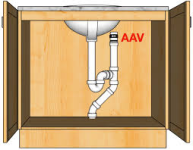
1765901515500.png

You will need: (
1 x Ptrap Adapter, 1-1/2" (this connects the drain to the filter basket tail piece)
1-1/2 - 1/2" ABS dishwasher tee (not shown in pic, install under Ptrap adapter over the PTRAP )
1 x union type Ptrap, 1-1/2" (the ones that unscrew in the middle) .
2' of 1-1/2" ABS (2' or so)
1 x 1-1/2" TY ABS fitting (this is where the Ptrap dumps into the drain and the vent connects vertically.)
1 x 1-1/2" 45 ABS fitting (female-female)
1 x 1-1/2" 45 ABS street fitting (female-male, fits into the bottom of TY fitting
1 x AAV (air attmittace valve -- be sure it's CSA approved, the $10 units don't always meet code- they risk flooding.
You'll need a small can of ABS glue and a bit of Teflon tape for the AAV threads.

You can cut ABS with a chopsaw if you don't have an ABS cutter and reamer, jusr be sure to debur the cut edges of the pipe using a knife or 80 grit sandpaper.

Dryfit everything before gluing.

Hope this heps.
 
Oil based paint is getting pretty hard to source , although when you read the chemistry on latex , there is a lot of “not water” in there.
The roll and tip method can produce a beautiful finish , cabinet design trends in the UK and north east US right now are brush finish on kitchens . It’s labour intensive so we may not see it here beyond custom work.
My original trade was autobody , I sprayed with a DeVilbis JGA siphon gun , later a top feed . Now I have a Graco ( because it’s easy to get parts ) but the princess auto HVLP top feed twenty buck guns are fantastic and I have both size needles they sell , it’s a great gun for small projects and hard to beat for the price . Graco , six hundred, PA twenty bucks ……


Sent from my iPhone using GTAMotorcycle.com
The local ship chandler will have good oil paint but in shippy colours. I have a bunch of spray guns including a 50+ year old DeVilbis but haven't used them for ages. The cleanup is hard to justify for small projects.

The Graco battery model uses A DeWalt battery but is also available in Class 1 Div 1 for people spraying more volatile products. It's a few hundred more for the C1 D1.
 
It's likely wrong. The second capped pipe is almost certainly a vent. After you clear the clog, fill the sink as high as possible, remove the drain plug and time how long it takes to empty - if you hear gurgling (like when you pour a gas can without opening the vent), the line isn't properly vented. Fill the sink again, this time remove the cap on the pipe to the left. If it drains a lot faster and doesn't guggle -- that second line is your vent.

To check for a Ptrap, use a 4" hole saw and punch thru behind the existing pipes. That's enough access to feel around for a PTRAP. use the cutout to repair the inspection hole.

No PTRAP found? Do this:

View attachment 77043

You will need: (
1 x Ptrap Adapter, 1-1/2" (this connects the drain to the filter basket tail piece)
1-1/2 - 1/2" ABS dishwasher tee (not shown in pic, install under Ptrap adapter over the PTRAP )
1 x union type Ptrap, 1-1/2" (the ones that unscrew in the middle) .
2' of 1-1/2" ABS (2' or so)
1 x 1-1/2" TY ABS fitting (this is where the Ptrap dumps into the drain and the vent connects vertically.)
1 x 1-1/2" 45 ABS fitting (female-female)
1 x 1-1/2" 45 ABS street fitting (female-male, fits into the bottom of TY fitting
1 x AAV (air attmittace valve -- be sure it's CSA approved, the $10 units don't always meet code- they risk flooding.
You'll need a small can of ABS glue and a bit of Teflon tape for the AAV threads.

You can cut ABS with a chopsaw if you don't have an ABS cutter and reamer, jusr be sure to debur the cut edges of the pipe using a knife or 80 grit sandpaper.

Dryfit everything before gluing.

Hope this heps.
That does help, thanks. Have a buddy coming by next week with a scope that I should be able to slide down beside the pipe without cutting to check for a Ptrap there.
 
Wife made a funny comment last night, and she's 100%.

'So we spent all this money and the house looks great...but I'm not really seeing any benefit in terms of heating the house as it's still cold'.

She's 100% right. We spent oodles of money, blood, sweat, time off, parental leave, and more time on all this work to insulate the damn exterior...and I'm still feeling cold walls, floors and a general minimal benefit from it.

Was it a full waste of time? Or do I now start looking for the easy 'wins'.

I'm planning on ripping out all the trim on the inside of the house and checking for leaks all around.

Also planning on ripping out my basement drywall and seeing if I can find air leaks coming in under the floor.

She's also asked me if we can consider making the house bigger....FML...buying a new house is stupidly expensive...I wonder how much it would cost to extend the rear by 10ft or so.
You can search for thermal leaks using a thermal imaging camera - accessories for smart phones are about $100, handhelds start around $200. They will pinpoint your leaks, saving you a ton of time over ripping out your trim work.

If your house is generally cold, there are several things to check:

1) Ductwork is open. There may be adjustable baffles in the ducts leading to rooms + the flow adjusters on the registers. Pull a register, reach in with your arm to see if you have baffles. If so, open the ones down stairs and partially restrict upstairs.

2) Check the balance doors where you Ductwork goes horizontal over your furnace. They are also used to balance airflow. Generally wide open in the winter.

3) Check furnace size. IUp till about 10 years ago a lot of installers put in furnaces that are way too large, as a result furnaces short cycle and done flow air long enough to maintain comfortable temps. My 1500sq bungalow had an 85000BTU furnace when I bought the place, I replaced it with a right sized 40,000 BTU furnace that spends a lot more time circulationg air and it's way more comfortable.

4) Air leaks. Your hands are usually good enough to feel small leaks (drafts). Check around exterior doors, windows, electrical boxes and a long the bottom of the baseboards -- a lot of older houses did not have sills sealed. If you're hands cant detect leaks, try a thermal imaging camera - accessories for smart phones are about $100, handhelds start around $200. They will pinpoint your leaks, saving you a ton of time over ripping out your trim work.
 
On this topic, products or tips to get rid of air leaks from door hardware (deadbolts, handles)?
When I install door locks in cold areas, I do the following:

1) Check the holes drilled through the latch and strike plates, if they are drilled all the way thru the door frame, seal the back cavity with foam. This eliminates a cold stream into the wall.

2) Seal the latch and deadbolt plungers with Roxul or Fiberglass insulation as packing. They are usually in loose and bad areas for leaking.

3) Another trick is to use a thin EVA foam gasket on the inside. Ive seen them come with high-quality locksets, but never found them for sale. I get the craft EVA foam sheets from Dollarama then cut gaskets to fit the inside of the latch. I cut the gaskets so 1mm protrudes on the inside of the latch and deadbolt plates to reduce thermal bridging if the door is steel. I poke holes in the gasket for the screws and lock mechanism. You can also seal that gasket to the door using acoustic sealant.

If you're really anal, acoustic sealant can be used to caulk around striker plates and the lockset screws. Don't use regular calking, to messy, to sticky and not great as a sealant in the cold.

I have to do this on doors we install in Northern Ontario, otherwise the moist air from inside the house ices up locks and latches on cold days.
 
When I install door locks in cold areas, I do the following:

1) Check the holes drilled through the latch and strike plates, if they are drilled all the way thru the door frame, seal the back cavity with foam. This eliminates a cold stream into the wall.

2) Seal the latch and deadbolt plungers with Roxul or Fiberglass insulation as packing. They are usually in loose and bad areas for leaking.

3) Another trick is to use a thin EVA foam gasket on the inside. Ive seen them come with high-quality locksets, but never found them for sale. I get the craft EVA foam sheets from Dollarama then cut gaskets to fit the inside of the latch. I cut the gaskets so 1mm protrudes on the inside of the latch and deadbolt plates to reduce thermal bridging if the door is steel. I poke holes in the gasket for the screws and lock mechanism. You can also seal that gasket to the door using acoustic sealant.

If you're really anal, acoustic sealant can be used to caulk around striker plates and the lockset screws. Don't use regular calking, to messy, to sticky and not great as a sealant in the cold.

I have to do this on doors we install in Northern Ontario, otherwise the moist air from inside the house ices up locks and latches on cold days.
Acoustic sealant works well but it rivals anti-seize for the messiest substance on earth. You will be finding black fingerprints on everything for years if even a tiny bit is exposed.
 
Acoustic sealant works well but it rivals anti-seize for the messiest substance on earth. You will be finding black fingerprints on everything for years if even a tiny bit is exposed.
Depends on the type.

It can be messy if not applied correctly, or if you're on it before it cures.

It' is the best product to seal cold gaps that require caulking because it doesn't react to cold (shrink, freeze or crack). I use it to seal outside wall vapor barrier to floors, poke thrus on sealed electrical boxes, and door hardware.
 
It's likely wrong. The second capped pipe is almost certainly a vent. After you clear the clog, fill the sink as high as possible, remove the drain plug and time how long it takes to empty - if you hear gurgling (like when you pour a gas can without opening the vent), the line isn't properly vented. Fill the sink again, this time remove the cap on the pipe to the left. If it drains a lot faster and doesn't guggle -- that second line is your vent.

To check for a Ptrap, use a 4" hole saw and punch thru behind the existing pipes. That's enough access to feel around for a PTRAP. use the cutout to repair the inspection hole.

No PTRAP found? Do this:

View attachment 77043

You will need: (
1 x Ptrap Adapter, 1-1/2" (this connects the drain to the filter basket tail piece)
1-1/2 - 1/2" ABS dishwasher tee (not shown in pic, install under Ptrap adapter over the PTRAP )
1 x union type Ptrap, 1-1/2" (the ones that unscrew in the middle) .
2' of 1-1/2" ABS (2' or so)
1 x 1-1/2" TY ABS fitting (this is where the Ptrap dumps into the drain and the vent connects vertically.)
1 x 1-1/2" 45 ABS fitting (female-female)
1 x 1-1/2" 45 ABS street fitting (female-male, fits into the bottom of TY fitting
1 x AAV (air attmittace valve -- be sure it's CSA approved, the $10 units don't always meet code- they risk flooding.
You'll need a small can of ABS glue and a bit of Teflon tape for the AAV threads.

You can cut ABS with a chopsaw if you don't have an ABS cutter and reamer, jusr be sure to debur the cut edges of the pipe using a knife or 80 grit sandpaper.

Dryfit everything before gluing.

Hope this heps.
Hey Mike, how did you do that drawing?
You seem to know a lot about plumbing I might need your input on a bathroom sink I have with a weird drain issue.
I'll post more later on.
 
Hey Mike, how did you do that drawing?
You seem to know a lot about plumbing I might need your input on a bathroom sink I have with a weird drain issue.
I'll post more later on.
I didn't draw that pic, it's clipart I got from somewhere - I keep a bunch of general construction pics on my phone.

My retirement side hustle is mostly plumbing -- I know my way around -- I'll help if I can.
 
Back
Top Bottom