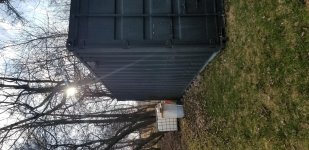







Sea container storage.

timtune

Well-known member
Site Supporter
A buddy has offered to let me store my 2 snowmobiles in his sea can. I'm a bit leery thinking it could be damp and full of condensation. This fellow had stored some wooden furniture in it and the finish was water damaged. Another friend has a sea can at his cabin and says he has no issues.

Outside storage for two sleds would open so much space in the garage. Anyone done this? doing this? Had issues?
 
A buddy has offered to let me store my 2 snowmobiles in his sea can. I'm a bit leery thinking it could be damp and full of condensation. This fellow had stored some wooden furniture in it and the finish was water damaged. Another friend has a sea can at his cabin and says he has no issues.

Outside storage for two sleds would open so much space in the garage. Anyone done this? doing this? Had issues?
We use them at the motorcycle course.

We put vents in them. Either a roofing style "turbine", or side vent with an overhang and a fan. Good for clearing out exhaust fumes, fuel vapour, and moisture accumulation.


Sent from my SM-S921W using Tapatalk
 
I would def check whether water is getting in from the top or bottom as there may be small penetrations that allow water in.

If you have power I’d consider adding a powered vent fan to the exterior.

If no power, I’d consider a solar powered fan to ensure there is circulation inside.
 
@NuggyBuggy used seacan at his cottage after his garage decided to immolate.

EDIT:
I think the key is keeping air exchanging. As SS said, big temp swings will cause condensation. Air exchanges mean the condensation should be gone in a day or two (until the next temp drop). Depending on the value of the stuff, running a dehumidifier in the can during the spring might be worthwhile. I run one in my mostly unheated garage during winter/spring as the cars bring in a ton of moisture.
 
Last edited:
A buddy has offered to let me store my 2 snowmobiles in his sea can. I'm a bit leery thinking it could be damp and full of condensation. This fellow had stored some wooden furniture in it and the finish was water damaged. Another friend has a sea can at his cabin and says he has no issues.

Outside storage for two sleds would open so much space in the garage. Anyone done this? doing this? Had issues?
No worse than an unheated building in my experience it is this time of year that everything gets coated in condensation with the extreme temp swings.

Sent from my Pixel 5 using Tapatalk
 
I have a friend who stored a boat in his in Haliburton area.
He did it for 2-3 years over the winter and did not report any issues.
 
We use them at the motorcycle course.

We put vents in them. Either a roofing style "turbine", or side vent with an overhang and a fan. Good for clearing out exhaust fumes, fuel vapour, and moisture accumulation.

Ours don't have any vents, but I don't think these things are designed to be hermetically sealed. Never a problem with moisture, or fumes build-up.

Mind you, the Okanagan is dry as hell, even in the wintertime, so there's that...
 
Ours don't have any vents, but I don't think these things are designed to be hermetically sealed. Never a problem with moisture, or fumes build-up.

Mind you, the Okanagan is dry as hell, even in the wintertime, so there's that...
My dad also has one up north in Haliburton. No venting. But its full of scaffold, cement mixer, lawn equipment, seasonal tools. Mostly stuff he doesn't care too much about.

They're a great option, if you have the space.

Sent from my SM-S921W using Tapatalk
 
If my wife was cool with adding a container to our front yard or rear yard we’d have on. But in the end it’s a matter of getting rid of junk not adding.
 
The sea cans that go cheap could be unusable for shipping. Check for leaks and possibility of toxins.

They may also go cheap due to the cost of shipping them back to the Pacific rim. Sometimes there's a glut.

I don't know if desiccants (Calcium chloride) help.
 
We have sea cans for our gear up north. We have solar powered roof vents to exhaust fumes (diesel, gas).

They cost about $100 on Amazon.
 
Asia is also building “one trip” containers , fuel to get them home costs more than selling it off here . You can also buy new containers made here , actually made for display and pop up markets , trade shows , tiny modular homes . This stuff seems built to a lot of different grades .
Friend is using two at the cottage for sleds / quads ect . Spaced them twelve ft apart and put a truss roof down the middle for parking the tractor. He says no condensation issues he’s noticed .


Sent from my iPhone using GTAMotorcycle.com
 
Ours don't have any vents, but I don't think these things are designed to be hermetically sealed. Never a problem with moisture, or fumes build-up.

Mind you, the Okanagan is dry as hell, even in the wintertime, so there's that...
Depending on the amount of sun the container gets get...first year did not add vents and RMX had rust spots on rotors, Installed 2 dryer vents kiddie corner with 2 120mm fans to 20w solar panel cured that problem.

20260406_181049.jpg

20260406_181059.jpg
 
I had a car stored in one for years, we had two big issues...

First, condensation, there was no roof vent in the one we had and temperature swings could cause it to basically rain inside.... I think ventilation would have solved this, specially active vents at the highest point.

Second, mice, this was an anomaly and should not have been a problem other than when the container was put in place a rock punctured the floor (pretty small hole, we didn't notice until we had the mice problem), once the mice found the way in it was an orgy....
 
Condensation in a container would supposedly be similar to walking around outside wearing glasses in winter and then coming inside. The cold glasses immediately fog up. Your jacket doesn't because of thermal mass and conductivity.

I see the same think happening when warm air enters the container, touching the metal inside the container, including the walls and ceiling. It's like breathing on your glasses to clean them.

Venting allows moisture to evaporate over time but doesn't it also allow more moisture laden air in to condense on a cold piece of steel?

Heating the steel to above the dew point using a humidistat and heater(s) would resolve the issue but heating an un-insulated container isn't easy or cheap.

Working inside the can in winter could add to the problems. Notice how car windows fog up in winter when a few people get in. We breath out a lot of moisture.
 
Condensation in a container would supposedly be similar to walking around outside wearing glasses in winter and then coming inside. The cold glasses immediately fog up. Your jacket doesn't because of thermal mass and conductivity.

I see the same think happening when warm air enters the container, touching the metal inside the container, including the walls and ceiling. It's like breathing on your glasses to clean them.

Venting allows moisture to evaporate over time but doesn't it also allow more moisture laden air in to condense on a cold piece of steel?

Heating the steel to above the dew point using a humidistat and heater(s) would resolve the issue but heating an un-insulated container isn't easy or cheap.

Working inside the can in winter could add to the problems. Notice how car windows fog up in winter when a few people get in. We breath out a lot of moisture.
Ventilation does bring in some moisture but it also reduces the temp delta between inside and outside of container. That reduces condensation. Ideally, the fan would be controlled with humidistats and thermostats. I haven't fully thought through the ideal logic but something like fans on when humidity in container is higher than humidity outside container or temp inside container is lower than temp outside container. I'd need to think more about what to do when humidity and temp outside container are lower than inside. In practice, solar powered forced ventilation appears to be sufficient to solve the problem with no thinking required.
 
There are numerous articles on why cans, designed for shipping don't make good houses without a ton of modifications, largely insulation. Depending on the method chosen the can could be thought of as the equivalent of siding for a conventional shed.

Foaming a container goes from ~ $2K to $8K depending on size and DIY vs Pro. Then a small plug in heater should keep the relative humidity down while making it into a more comfortable shop. Containers are from $2K to $10K bare so $4K to $18K insulated. Is it worth it?

One could probably cobble together a 12' X 12' OSB shed for a competitive amount. Making it look pretty would be the expensive part.
 
Back
Top Bottom