






Enough of COVID...what are you doing to the house?

Hey everyone, I am back for the solid advice this place always had. The internet is dead these days, and this forum really knows it's stuff

I am redoing the flooring throughout the house and the kitchen. The kitchen is IKEA SEKTION based, and the flooring is Fuzion Laminate Nautiq Pro, 9 1/4 inch by 60 inch click flooring. Has anyone used this flooring?

Main question is the island. It will be about 9 feet long with a sink, dishwasher, and heavy countertop. General advice is not to install cabinets or islands on top of the flooring, but I see plenty of kitchens done that way. Because IKEA cabinets sit on legs, I am worried the weight could make the flooring bow, lift, or make noise. IKEA has a SEKTION floor anchoring frame, but it still only rests on a few brackets. I am thinking of building a 2x6 box frame to support the island more evenly. So should the flooring go under the island, or stop at the island footprint? If I stop it behind the kickboard, I am worried spills could run under the exposed flooring edge. Now that I have spent five hours writing and rewriting the above, I am starting to think the best approach is to lay the flooring first. Then I can build my box frame with adjustable legs at every joist and use a hole saw to cut out the flooring at each leg location. My box frame would support the bulk of the weight, while the outside IKEA legs would sit on the flooring mainly to hold the kickboards.
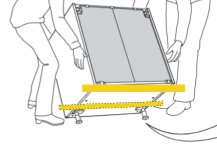
These are the legs I am thinking to use View attachment 78641

Any real world experience with this setup?

You have great advice from above. That will let you move the island later if you really need to.

My 10 cents is to get an installation kit like this Laminate/Vinyl Flooring Tools, NAACOO Tapping Block for Vinyl Plank Flooring-Double Sided with Notches,10In Contour Gauge, Pull Bar, 40Pcs Floor Spacers,Rubber Mallet. Universal Floor Installation Kit : Amazon.ca: Tools & Home Improvement

I found the tools in these to be very helpful on an install of click flooring and you have them for your next install too.
 
Solid advice, everyone. Thanks. I will chew on it, but I am definitely building a box.

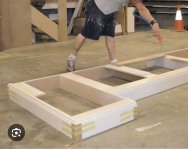
I thought dimensional lumber was the best choice. My first thought was plywood or OSB on edge, but stacked 6 inch strips with staggered joints, log cabin style, sounds way better and not too hard to build.

If I do not put flooring underneath the cabinets, I am still deciding whether to skip the IKEA legs completely or leave the front legs in place and set my frame behind them. The setback would help protect the flooring edge from spills, but it also moves the main support back, which might not be ideal for weight distribution. I could make the last few plywood strips wider under the cabinet to keep the setback while still giving full support. Full flooring and box all around is easier though.
1778184546043.png

What is the preferred way to level this frame and the cabinets? It feels a bit wrong to build a fancy frame only to have it sit on shims. Do I just shim it at every joist, or under every vertical wall of the cabinet?

The kickboards and mounts are pretty flexy, so caulking them to the flooring should not cause issues.

One more thing. For the plumbing, electrical, and ductwork, I need to remove a fair amount of subflooring. When I replace it, does the floating edge really need blocking toe-screwed to the joists, or can I just use a plywood piece underneath with glue and two rows of screws on each side? I am probably overthinking this, but the full blocking feels a bit excessive.
 
My ceiling insulation that turned into a new peaked roof over a flat roof issue is nearly coming to a close. Engineers, architects and planning permission all done and they start in a few weeks. For the tie in for the new peaked roof to the existing peaked roof we have been offered a new shingle job so as to save the workers from doing surgery with the existing shingles at the tie in point. Materials only, no labour so it looks like we will get the existing peaked roof reshingled for less than $2k which seems like a major bonus.
 
Solid advice, everyone. Thanks. I will chew on it, but I am definitely building a box.

I thought dimensional lumber was the best choice. My first thought was plywood or OSB on edge, but stacked 6 inch strips with staggered joints, log cabin style, sounds way better and not too hard to build.

If I do not put flooring underneath the cabinets, I am still deciding whether to skip the IKEA legs completely or leave the front legs in place and set my frame behind them. The setback would help protect the flooring edge from spills, but it also moves the main support back, which might not be ideal for weight distribution. I could make the last few plywood strips wider under the cabinet to keep the setback while still giving full support. Full flooring and box all around is easier though.
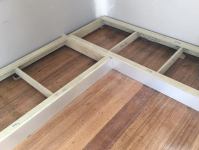
View attachment 78647

What is the preferred way to level this frame and the cabinets? It feels a bit wrong to build a fancy frame only to have it sit on shims. Do I just shim it at every joist, or under every vertical wall of the cabinet?

The kickboards and mounts are pretty flexy, so caulking them to the flooring should not cause issues.

One more thing. For the plumbing, electrical, and ductwork, I need to remove a fair amount of subflooring. When I replace it, does the floating edge really need blocking toe-screwed to the joists, or can I just use a plywood piece underneath with glue and two rows of screws on each side? I am probably overthinking this, but the full blocking feels a bit excessive.
A ladder frame for the kick faced with the cabinet exterior material. Only solid wood touches the floor. So plywood on edge. No shims. Scribe to floor.
A power plane is your friend.

Screenshot 2026-05-07 at 6.20.03 PM.png
 
Planer makes sense, thanks.

What do you mean by "Only solid wood touches the floor. So plywood on edge." Do I build it out of real lumber or plywood?
 
Planer makes sense, thanks.

What do you mean by "Only solid wood touches the floor. So plywood on edge." Do I build it out of real lumber or plywood?
Sorry. Kick is made of plywood. Solid wood is glued to the outside (what you see) of the kick.
Kinda like this

IMG_4951.jpeg
 
Last edited:
Solid advice, everyone. Thanks. I will chew on it, but I am definitely building a box.

I thought dimensional lumber was the best choice. My first thought was plywood or OSB on edge, but stacked 6 inch strips with staggered joints, log cabin style, sounds way better and not too hard to build.

If I do not put flooring underneath the cabinets, I am still deciding whether to skip the IKEA legs completely or leave the front legs in place and set my frame behind them. The setback would help protect the flooring edge from spills, but it also moves the main support back, which might not be ideal for weight distribution. I could make the last few plywood strips wider under the cabinet to keep the setback while still giving full support. Full flooring and box all around is easier though.
View attachment 78647

What is the preferred way to level this frame and the cabinets? It feels a bit wrong to build a fancy frame only to have it sit on shims. Do I just shim it at every joist, or under every vertical wall of the cabinet?

The kickboards and mounts are pretty flexy, so caulking them to the flooring should not cause issues.

One more thing. For the plumbing, electrical, and ductwork, I need to remove a fair amount of subflooring. When I replace it, does the floating edge really need blocking toe-screwed to the joists, or can I just use a plywood piece underneath with glue and two rows of screws on each side? I am probably overthinking this, but the full blocking feels a bit excessive.
Too much thinking!

I know it’s your time, but overthinking ways to do things is the #1 reason DIY goes slowly or never gets finished. For example, blocking a subfloor vent cutout takes a scrap 2x4, handful of screws and 5 minutes. It’s not hard to spend 10x that time thinking of another or better way to do things.

A few things :
Levelling your base can be done using a hand plane or shims. For planing, trace a level line from the lowest point (your zero coordinate) then plane of sand to the line. Don’t be afraid of shims, the world is built on them, much faster.

Mechanical thru floor. You shouldn’t need to remove much for mechanical. 2-3/4” hole saw is the standard size for 2” abs, 1” is common for electrical stove wire, and 6” for ductwork.

Repairing subfloor cutouts- save the cutout, cut a backer from 2” lumber or 5/8” or better ply. Cut a backer that overlaps your cutout by 2”, screw. You can glue too, but it’s bot necessary.
 
Back
Top Bottom