You do a quiz that helps determine your risk tolerance, desired return, capacity to take risk, etc. From the answers, the robo advisor can pick investments that try to fit your profile. Much safer than people with little knowledge or interest picking their own.
In the past, people with little money couldn't get good financial advice as the good advisors wanted too much money yearly and the fees would eclipse the gains from advise. Robo-advisors help fill that need.
If robo-advisor doesn't give you confidence, depending on your time frame and use case for the money, XEQT and chill isn't awful. That could also be bad advice if you plan on using the money for something in the near future.
You do a quiz that helps determine your risk tolerance, desired return, capacity to take risk, etc. From the answers, the robo advisor can pick investments that try to fit your profile. Much safer than people with little knowledge or interest picking their own.
In the past, people with little money couldn't get good financial advice as the good advisors wanted too much money yearly and the fees would eclipse the gains from advise. Robo-advisors help fill that need.
If robo-advisor doesn't give you confidence, depending on your time frame and use case for the money, XEQT and chill isn't awful. That could also be bad advice if you plan on using the money for something in the near future.
thanks for that...we sold his rental last summer which he jointly owned with his mom (2 semis) so this is the remainder after his mom paid capital gains on her portion...no idea how much he's thinking of 'playing' with but I'm definitely a GIC type of girl I'll look into this a bit more before helping him decide...oh, we retire in 2 years and honestly, he doesn't have much (other than what he received from selling his rental last year) and CPP at 60 sucks so I'd rather he not play with it...
thanks for that...we sold his rental last summer which he jointly owned with his mom (2 semis) so this is the remainder after his mom paid capital gains on her portion...no idea how much he's thinking of 'playing' with but I'm definitely a GIC type of girl I'll look into this a bit more before helping him decide...oh, we retire in 2 years and honestly, he doesn't have much (other than what he received from selling his rental last year) and CPP at 60 sucks so I'd rather he not play with it...
thanks for that...we sold his rental last summer which he jointly owned with his mom (2 semis) so this is the remainder after his mom paid capital gains on her portion...no idea how much he's thinking of 'playing' with but I'm definitely a GIC type of girl I'll look into this a bit more before helping him decide...oh, we retire in 2 years and honestly, he doesn't have much (other than what he received from selling his rental last year) and CPP at 60 sucks so I'd rather he not play with it...
Obviously we don't know the whole picture and aren't licensed to give financial advice but given your paragraph, I would strongly advise doing what you could to push CPP to 70. That gives him almost double the monthly payments for life. To accomplish that, he may need to burn through the rental property money to live in the meantime. When that close to retirement, ideally you have at at least two years of necessary spending (and potentially up to five) that can't go down (a combination of high interest savings, gics, bonds, etc). Given your DB pension, that may not be a huge number as your pension can do a lot of work. The path for the rest of the money is partially determined by how much there is. Conceptually, you want the rest to be invested in something with a decent (but not guaranteed) chance to grow faster than inflation. In years where this bucket is up, you pull from it. In years where it's down, you pull from your safer bucket to give the second bucket time to recover. As this method already has the safety built into bucket one, I like foot to the floor on bucket two (something like XEQT, VT, etc).
I'd strongly recommend retaining a fee for service advisor asap. Having them prepare a plan for both of you costs ~$4000 but can easily save you tens or hundreds of thousands by helping you make the right choices (which aren't always obvious like spending all your money now instead of starting CPP at 60). It also gives you comfort as a good plan shows how much money you can safely spend each year and where it is coming from. They can also help him with a plan for the current cash influx (likely max TFSA's first, after that RRSP vs non-reg depends a lot on current income). If you want the $50 version, Adviice lets you do it yourself but while I am using that to run scenarios for myself, I am still going to pay someone that does this for a living to make sure I didn't miss something important.
EDIT:
As for his desire to play in the market. Do that with a percentage if he must (5-10%). Never refill that bucket. Keep that money in a different brokerage to make it clear that it is distinct and not to be co-mingled. If it grows to 1M, good for him. If he loses it all, it didn't change the path through your life all that much. If you refill that bucket after a loss, it is easy to get to a place where all the money is gone.
Wealthsimple.com has a robo investor, it’s an automated money manager. You tell it about your risk tolerance and it manages your portfolio for you.
You fund it like a savings account, either transferring in a traunch of money or doing automatic scheduled transfers from your regular bank account.
I’m comparing the return with my money manager, so far they are about the same, but I have some healthy fees every year, Wealth simple fees are 1/2 of a percent, or about 1/3rd the cost of TD wealth.
If hubby is running into more than $300k that he can invest and hold, I’d seek out a wealth manager (not a dumbass financial planner, a wealth manager). The entry for these managers differs by firm, Canadian banks entry is between $250k-$300k, Fisher, Asante, Raymond James are $500-$1m.
If it’s less than $250k, robo investors seem to be doing well these days.
Tip: don’t drop into a retail branch for advice. Their ‘investment advisors’ are just salesmen for the banks financial products - few customers understand this Wealth managers don’t work at retail branches.
Tip: don’t drop into a retail branch for advice. Their ‘investment advisors’ are just salesmen for the banks financial products - few customers understand this Wealth managers don’t work at retail branches.
Check your Health Spending Accounts people! I get $500 but if I use all of $500 then $200 goes to taxes, and I only get $300 toward whatever it is that I'm buying under that account.
However, there are options that you can transfer the full $500 to a TFSA or an RSP and you get all of the $500.
I'd rather do that, and just use my own $300 for something.
Check your Health Spending Accounts people! I get $500 but if I use all of $500 then $200 goes to taxes, and I only get $300 toward whatever it is that I'm buying under that account.
However, there are options that you can transfer the full $500 to a TFSA or an RSP and you get all of the $500.
I'd rather do that, and just use my own $300 for something.
What? Transfering an HSA to a TFSA doesn't count as a taxable benefit? Are you sure you have that right? That doesn't correspond with normal tax rules. Transfering HSA to RRSP is also strange but the taxable event and contribution cancel out so no tax is due this year.
Full disclosure , Im a finacial idiot , sheer luck and coaching put me where I am . So the coaching . @madmike is 100% , the branch level finacial advisors took the short course and are "in" . Actual wealth advisors as you can find at RBC dominion security or Scotia McLeod are different and better , they can help with planning , tax advantages later and wealth transfer when the time comes. Small corner shops with an insurance agent that sell mutual funds and also does travel advice is not where you wanna be , IMO.
If your looking at the stock market , do not invest money that you potentially could not live without. Stuff happens. We have a bit of cash in a few spots , so if the ceiling falls in , we can afford to fix the ceiling.
Ive had an advisor for years , only once did the fees outweigh the gains , 2008, but everbody choked, and it all came back in three years. I'm a big believers in getting proffessional advice. I dont do my own dentistry.
What? Transfering an HSA to a TFSA doesn't count as a taxable benefit? Are you sure you have that right? That doesn't correspond with normal tax rules. Transfering HSA to RRSP is also strange but the taxable event and contribution cancel out so no tax is due this year.
I haven't dug into it much further than that...but my buddy's been transferring the full $500 annually for years and hasn't had anything taken out for it.
And I'd say he's as detail oriented as you.
@GreyGhost correction...it's the PERSONAL SPENDING ACCOUNT. Not the Health Spending Account:
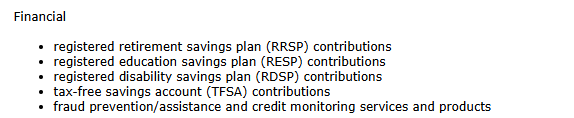
Eligible Expenses include:
EDIT #2: Just submitted a claim and I'll let you know next pay period if they take it off.
That's not easy to quantify. The answer to that question depends a lot on the chosen benchmark. If the benchmark is S&P500 and your risk profile calls for some risk-off assets, that's not fair to the advisor as they should lag the index even without fees. Advisor putting you into all tech since 2008 smokes the S&P500 but lags NASDAQ 100. Realistically, you want to be comparing risk-adjusted returns but most people have advisors as they don't understand (and/or don't want to understand) risk-adjusted returns. I haven't seen paperwork for a client that discusses risk adjusted returns (but I haven't seen reports from all wealth managers).
That's not easy to quantify. The answer to that question depends a lot on the chosen benchmark. If the benchmark is S&P500 and your risk profile calls for some risk-off assets, that's not fair to the advisor as they should lag the index even without fees. Advisor putting you into all tech since 2008 smokes the S&P500 but lags NASDAQ 100. Realistically, you want to be comparing risk-adjusted returns but most people have advisors as they don't understand (and/or don't want to understand) risk-adjusted returns. I haven't seen paperwork for a client that discusses risk adjusted returns (but I haven't seen reports from all wealth managers).
Risk is manages across a broad spectrum of securities by good wealth managers. You’re not gonna get an all in on SpaceX or AI stock, you’ll not gonna get returns that smoke the S&P.
They might ‘do as you ask’ and chase surging trends, but most won’t. Most will target several points above inflation, moving risk a bit based on the bears and bulls.
They generally perform well over the long term. My guys have averaged 12.1% ARR over the last 10 years. That doubles my portfolio value every 6 years.
They also do tax planning, moving my gains into TFSA, and keeping it at a slightly higher risk level. That’s been 12.9%, so doubling my money every 5.5 years.
Compared to my current house purchased in 2000, the wealth manager has outperformed real estate by 2:1.
Risk is manages across a broad spectrum of securities by good wealth managers. You’re not gonna get an all in on SpaceX or AI stock, you’ll not gonna get returns that smoke the S&P.
They might ‘do as you ask’ and chase surging trends, but most won’t. Most will target several points above inflation, moving risk a bit based on the bears and bulls.
They generally perform well over the long term. My guys have averaged 12.1% ARR over the last 10 years. That doubles my portfolio value every 6 years.
They also do tax planning, moving my gains into TFSA, and keeping it at a slightly higher risk level. That’s been 12.9%, so doubling my money every 5.5 years.
Compared to my current house purchased in 2000, the wealth manager has outperformed real estate by 2:1.
Over the last 10 years I averaged over 20% (Jan 1 2016 to Dec 31 2025). Sequence of returns matters a lot so averaging yearly returns is a slightly messed up way of looking at it and two good years at the beginning make a big difference to my result at the end. If I average the yearly returns of the last 10 years I get 20.9%. If I calculate the return that would be needed every year to get portfolio from value A to value B, I get ~25-27% (result changes a bit depending on how you account for compounding). The best year was +41%, the worst was -17%. Many people would not be happy with those swings but my ratios are working out well for risk-adjusted returns.
Over the last 10 years I averaged over 20% (Jan 1 2016 to Dec 31 2025). Sequence of returns matters a lot so averaging yearly returns is a slightly messed up way of looking at it and two good years at the beginning make a big difference to my result at the end. If I average the yearly returns of the last 10 years I get 20.9%. If I calculate the return that would be needed every year to get portfolio from value A to value B, I get ~25-27% (result changes a bit depending on how you account for compounding). The best year was +41%, the worst was -17%. Many people would not be happy with those swings but my ratios are working out well for risk-adjusted returns.
Probably. It's also easier with a smaller pool of money. As things scale, it gets harder.
My time weighted return over the last 17.5 years is 21.7%. Peter lynch did much better but in a different time. There are a lot of hedge funds that beat me.
Over time, I am putting more into less volatile equities (index funds, brk, etc) and have about 50% there now to minimize the chances of blowing up. The rest is buy and hold. Buys are 1-5% of portfolio depending on my conviction. If a position exceeds 10% it normally gets trimmed back to 5% except on rare occasions. At one point, I got close to 50% in one stock and that was profitable but insane. I was playing with fire so I sold off a lot of it. I don't know if I could make plays like that with client money. They would see a swing, find out they were overweight in something and pull out at a terrible time.
Bad choices can really hurt you. I would put most of your money in something like XEQT or VT and just let time work. As the canadian dollar is in the crapper, VT right now may not be the best choice. On the flip side, as you may retire in a foreign country, having all of your investments tied to canadian dollar is probably unwise.
You could put a bit in where I did a few weeks ago to try to beat the market with that portion. I'm down 3% on that position but I think it has a decent chance over the long-term.
I caught a dip in the S&P last week and just added more to an ETF (TPU).
Mimico…not sure what you have decided to do but my strategy is a few big names (Costco etc) and mostly S&P ETFs. I transfer a set amount every month into my TFSA and RRSP accounts and let it ride for a bit as cash and when things look unsettled I’ll put an offer in at a lower price on ETFs and let that offer ride for a week. Sometimes they get filled, sometimes they don’t. Rinse and repeat. I don’t have to manage things much at all and my S&P is up 30ish % over when I started doing this (admittedly only a few years). I have any dividends ploughed back in to stock buys.
I figure picking something obscure is really more gambling than anything else and I don’t want any part in that. Trying to spot trends is more of a guess for someone like me and I recognize that and don’t partake.
I am also a financial dumbass and have no idea what futures are etc. However, the advice I got was from a wealth advisor via a colleague in terms of reasonably safe investing.
This site uses cookies to help personalise content, tailor your experience and to keep you logged in if you register.
By continuing to use this site, you are consenting to our use of cookies.










 I'll look into this a bit more before helping him decide...oh, we retire in 2 years and honestly, he doesn't have much (other than what he received from selling his rental last year) and CPP at 60 sucks so I'd rather he not play with it...