







Aluminum foil + Coca-Cola + Motorcycle = Yes???

Electrolysis is another easy solution for rusty stuff. I would never do it on a tank as it will bubble away any paint that’s got a sliver of rust behind it.
What I did when I did electrolysis on my tank was:

- plug the drain,
- fill it with water and washing soda
- jury rigged some rebar bent into an L-shape so that it could project deeper into the recess of the tank.
- used some foam that I jammed in the filler hole to hold the rebar in place. Keeping the rebar from touching the inside of the tank to prevent it from shorting is a challenge.
- connected the rebar and a bare metal part of the tank to the charger. I always get what part goes to what terminal confused, so I ended up marking it on my charger. LOL

This way the paint wouldn't be jeopardized by the reaction that happens only internally, and I could get the sacrificial anode closer to the interior of the tank.

Just filling it with vinegar would have been easier for sure, especially since electrolysis is a line-of-sight process.

I feel like I'm sharing pictures of my dirty underwear here, but:
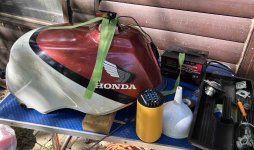
electrolysis setup.jpeg

Here's what I started with. All that paint flaking was there when I got it.
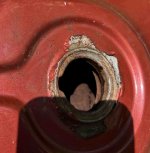
pre.jpeg

Here's what I ended up with after a few cycles and I had to call it a wrap because my wife didn't like the setup in front of the cottage. The red liquid is two-stroke mix I tossed in there to prevent rusting. Unfortunately I took this picture AFTER I put in the mix so it's covering the bottom of the tank and thus you can't see how clean the tank was. But it was pretty good. You could see bare metal. The de-rusting is perhaps most noticeable in these pictures around the lip of the filler hole, which is interesting as most of the time the solution was well below that level - it had to be, because I had a big foam plug in that hole. I'm not sure how THAT happens.
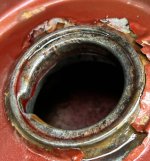
IMG_6597.jpeg

Here's a picture of the sacrificial anode after one of several rounds. Note all the crap that it has attracted to it in some spots (e.g. at ends) whereas in other spots (e.g. centre) it has shrunk. Each time I'd go for another round I'd sand/grind off as much of the crap on it to try and get back to bare metal or close to it.
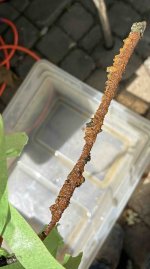
anode.jpeg

If I had to do it again, I'd use flat bar stock as @Mad Mike suggests, if for no other reason than it would be easier to remove the stuff that accumulates on it. I'd also put some rubber around the anode at strategic spots to keep it away from the tank and maybe allow me to put more anodes in there at the same time.

You need some scrap clean steel (no stainless) as your anode,
This part is important. Stainless steel in an electrolysis setup will release hexavalent chromium, which is extremely toxic and shouldn't be dumped. Graphite is apparently very good to use but if I recall it was expensive to source.
 
Last edited:
The aluminum foil trick works well on chrome as it is softer than the chrome but harder than the rust. The pits will still be there but it will look much better. As others noted, the fluid is for lubrication and water will work the same for all practical purposes. Coke etc. will just make it sticky or whatever, the acid is way too mild to do anything meaningful for the time it is in contact. There is lots of derivative content online that says otherwise about coke etc., but it is just that derivative... Bicycle guys use this in restoration often (with water of course). I have cleaned up vintage chrome rims, fenders, and handle bars this way, you just need to take care of it afterwards (simple as some polish every now an again) as the rust will come back otherwise, the chrome still has pits.

For non-chrome electrolysis works great, cheap 12v battery charger is what I use as a power source, just make sure you have the polarity correct otherwise your part becomes the sacrificial electrode!

Vinegar also works on many things in a soak, normal is 5%, pickling is 7%, cleaning is 10%....FYI. I use cleaning....

Of course there are also more expensive rust remover OTS products.

The approach will depend on time and what you are restoring (material, shape, etc.).
 
Today I learned I am derivative.

Tomorrow I hope to learn whatever the **** that means.
 
No babysitting. Dump it in, 24 hours later dump it out.
I understood there was a risk of leaving it in too long and having the vinegar eat the metal. That was my worry - I had no guarantee I was going to be able to get back within 24-hours. The very notion that it COULD eat the metal gave me some pause.
 
Last edited:
I understood there was a risk of leaving it in too long and having the vinegar eat the metal. That was my worry - I had no guarantee I was going to be able to get back within 24-hours. The very notion that it COULD eat the metal gave me some pause.
You have a long window, up to 72 hours. The worst I’ve see if you leave it 72 hours is a light etching - it’s not gonna dissolve the tank.

If it’s surface rust, just vinegar. If it’s flaking or crusted, drop in a small length of chain, or a handful of nuts on a string, then shake the tank to break up heavy scale.
 
Today I learned I am derivative.

Tomorrow I hope to learn whatever the **** that means.
Not intended specifically for you. The term is for content providers that just regurgitate other content providers' content as their own, no new information, just now in their words, take the other content as fact and promote is as fact making their own video. Their content is just derivative of other peoples content, no new info.

There is a crap tonne of it out there. Lots of misinformation as people are just parroting other people's content to get the views...
 
Last edited:
I understood there was a risk of leaving it in too long and having the vinegar eat the metal. That was my worry - I had no guarantee I was going to be able to get back within 24-hours. The very notion that it COULD eat the metal gave me some pause.
A friend tried to clean some putty knives and left them for a week or more. They were shot.
 
You have a long window, up to 72 hours. The worst I’ve see if you leave it 72 hours is a light etching - it’s not gonna dissolve the tank.

If it’s surface rust, just vinegar. If it’s flaking or crusted, drop in a small length of chain, or a handful of nuts on a string, then shake the tank to break up heavy scale.
Is kitchen vinegar enough or do you usually need something more concentrated?
 
Is kitchen vinegar enough or do you usually need something more concentrated?
For the inside of a tank, you can use regular white vinegar(5% acetic acid). Cleaning vinegar also works (10%) but you need to be more careful with time, it works faster, but it also etches faster - so 12 hrs max. Vinegar isn’t all that helpful cleaning rust off other parts - it’s not aggressive and it works very slowly.

Harpic bleach is the same as toilet bowl cleaner. It’s ok for stainless but use it carefully, it will help remove rust, tarnish and discoloration from stainless but it also etches if left on too long or if you don’t neutralize. Don’t get it on paintwork, aluminum or titanium parts.
 
Love that this has sparked a conversation that lets people learn more and get way more value than I could provide on my own. You guys are the best 👌
 
Love that this has sparked a conversation that lets people learn more and get way more value than I could provide on my own. You guys are the best 👌
Do a video on electrolysis. I’ll give you support on your setup. There are plenty on YouTube, but another well done video explaining the process and science could be helpful.
 
Do a video on electrolysis. I’ll give you support on your setup. There are plenty on YouTube, but another well done video explaining the process and science could be helpful.
Too far outside of my wheelhouse, I'd be a fraud. Can barely spell electrolysis, plus with the concussion from last year's accident, learning anything new is still a tall task :\

I'm livin' la vida Homer Simpson these days.
 
It's really dead simple. The hardest thing for me was sourcing an old-school charger and making sure the sacrificial rod doesn't short out against the tank - if you're not trying to de-rust the inside of a tank, it's way easier.

It might make good follow-up content for you @adri. I know I've watched a bunch of videos. If you want me to bring my ugly-ass setup down, let me know.
 
Whatever chemistry you guys get playing with , please get a chemical respirator and be in a vented area .
You’re not cooking meth , but none of this stuff is good for your lungs .


Sent from my iPhone using GTAMotorcycle.com
 
Whatever chemistry you guys get playing with , please get a chemical respirator and be in a vented area .
You’re not cooking meth , but none of this stuff is good for your lungs .


Sent from my iPhone using GTAMotorcycle.com
I understood electrolysis on non-stainless steel is perfectly safe at least in terms of toxicity of gases emitted?

I do believe the emitted gases can be explosive though. I do run it outside only for that reason.
 
Whatever chemistry you guys get playing with , please get a chemical respirator and be in a vented area .
You’re not cooking meth , but none of this stuff is good for your lungs .


Sent from my iPhone using GTAMotorcycle.com
Removing rust using electrolysis produces H2 4l/hr) and O - neither of these are toxic in the concentrations produced.
 
Back
Top Bottom




