







What I did when I did electrolysis on my tank was:Electrolysis is another easy solution for rusty stuff. I would never do it on a tank as it will bubble away any paint that’s got a sliver of rust behind it.
- plug the drain,
- fill it with water and washing soda
- jury rigged some rebar bent into an L-shape so that it could project deeper into the recess of the tank.
- used some foam that I jammed in the filler hole to hold the rebar in place. Keeping the rebar from touching the inside of the tank to prevent it from shorting is a challenge.
- connected the rebar and a bare metal part of the tank to the charger. I always get what part goes to what terminal confused, so I ended up marking it on my charger. LOL
This way the paint wouldn't be jeopardized by the reaction that happens only internally, and I could get the sacrificial anode closer to the interior of the tank.
Just filling it with vinegar would have been easier for sure, especially since electrolysis is a line-of-sight process.
I feel like I'm sharing pictures of my dirty underwear here, but:
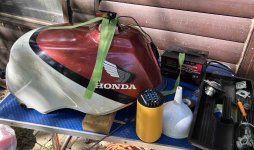
Here's what I started with. All that paint flaking was there when I got it.
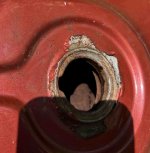
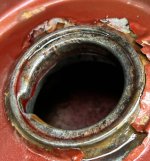
Here's what I ended up with after a few cycles and I had to call it a wrap because my wife didn't like the setup in front of the cottage. The red liquid is two-stroke mix I tossed in there to prevent rusting. Unfortunately I took this picture AFTER I put in the mix so it's covering the bottom of the tank and thus you can't see how clean the tank was. But it was pretty good. You could see bare metal. The de-rusting is perhaps most noticeable in these pictures around the lip of the filler hole, which is interesting as most of the time the solution was well below that level - it had to be, because I had a big foam plug in that hole. I'm not sure how THAT happens.
Here's a picture of the sacrificial anode after one of several rounds. Note all the crap that it has attracted to it in some spots (e.g. at ends) whereas in other spots (e.g. centre) it has shrunk. Each time I'd go for another round I'd sand/grind off as much of the crap on it to try and get back to bare metal or close to it.
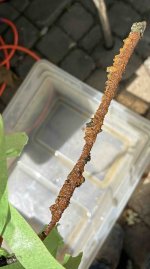
If I had to do it again, I'd use flat bar stock as @Mad Mike suggests, if for no other reason than it would be easier to remove the stuff that accumulates on it. I'd also put some rubber around the anode at strategic spots to keep it away from the tank and maybe allow me to put more anodes in there at the same time.
This part is important. Stainless steel in an electrolysis setup will release hexavalent chromium, which is extremely toxic and shouldn't be dumped. Graphite is apparently very good to use but if I recall it was expensive to source.You need some scrap clean steel (no stainless) as your anode,
Last edited:






