
First choice would be caulking.Recommendations on thisshow and how to fix this gap…
Second choice, 1/4" quarter round or some other trim, maybe even door stop used like a little baseboard...







First choice would be caulking.Recommendations on this

Use Pex. If I were in town I’d give you a hand, the tools are a bit pricy.Thanks!
I’ll also have to replace some copper pipes with something else as they’re against the wall and will need to be moved away.

I have the poverty version with rings and manual crimper he can borrow. Not as good as expansion pex but good enough for the few times I needed itUse Pex. If I were in town I’d give you a hand, the tools are a bit pricy.


@mimico_polakUse Pex. If I were in town I’d give you a hand, the tools are a bit pricy.
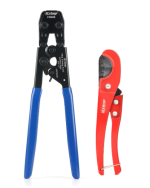
PexB. That works fine, it’s cheaper and you can get everything at Home Depot.I have the poverty version with rings and manual crimper he can borrow. Not as good as expansion pex but good enough for the few times I needed it
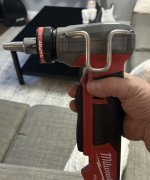
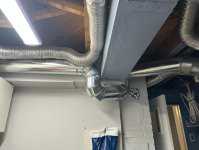
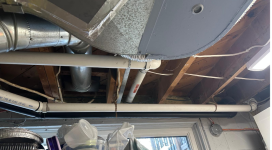
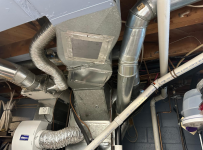
Ceiling needs to be at least 7' or it will feel awful. You could use low profile transfer ducts under the beam to get back a bunch of height. You can probably use the brake you already have and add tin-knocker to your list of skills.Thanks everyone for the offers and suggestions. There are only 2 water lines to replace if I can't fit the drywall behind the current copper lines. It's only for the washer/dryer and sink from the water tank.
My bigger concern is what to do with the ceiling, as covering it up will leave a 6ft ceiling at best.
View attachment 77633
View attachment 77634
View attachment 77635
Might just leave the work to installing the insulation, drywall, and a pony panel that I've got laying around for future upgrades to the house (and potential hot tub / pool).
A lot lower flow than copper. Each Pex B fitting reduces flow by the same amount at 15’ of pipe. Pex A is full bore so fittings only add about 2’ of pipe loss, and you don’t need nearly as many fittings with A.We had the whole house replumbed ( Kytec plumbing ) 6yrs ago . They used an electric crimper , not the expansion tools. They felt they liked the mechanical connection . I'd guess they had invested in all the tools and that was how they were taught. It has a lower flow rate than copper for sure , but not enough that i notice anything.

They didn't glue the joints. Very few do.I feel like I'm filling vanity/trim cracks with caulking every winter. Maybe using a humidifier during Jan-Feb would be the answer.

Many people have a lot of plants in their homes, and will often think their windows are needing replacement when they're just crying / gathering water along the edges.If humidity goes over 50%, my windows start crying.
We have one small flower and one pot of basil right now. My wife is amazing at killing plants. I can look outside and see nature. I don't need the hassle of watering 100 pots.Many people have a lot of plants in their homes, and will often think their windows are needing replacement when they're just crying / gathering water along the edges.
All the plant watering is usually a major source of humidity.
Properly vented high-efficiency gas furnace should not effect humidity as the combustion is closed loop using outdoor air. Many lazy installers don't bother with outdoor air intake and just put a grille over the intake. Any appliance that pushes conditioned air out lowers humidity in winter. That would include most fireplaces (some are sealed combustion with outdoor makeup air into fire box), most gas water heaters (are there on-demand heaters with sealed combustion?), exhaust fans, HRV, etc.I run a furnace humidifier and keep the house at thirty five percent in the winter . Gas fireplaces and gas furnace dries the place out . Trim stays tight , furnitures doesn’t crack and my windows get a wipe down daily . I’ll gladly deal with wet windows vs cracked veneer on tables .
Sent from my iPhone using GTAMotorcycle.com
Forced air heating does dry air and reduce humidity. Radiant no.Properly vented high-efficiency gas furnace should not effect humidity as the combustion is closed loop using outdoor air. Many lazy installers don't bother with outdoor air intake and just put a grille over the intake. Any appliance that pushes conditioned air out lowers humidity in winter. That would include most fireplaces (some are sealed combustion with outdoor makeup air into fire box), most gas water heaters (are there on-demand heaters with sealed combustion?), exhaust fans, HRV, etc.

That explains a lot, my place is 99% pex b and flow is low, nothing earth shattering but low enough to notice when having a shower.A lot lower flow than copper. Each Pex B fitting reduces flow by the same amount at 15’ of pipe. Pex A is full bore so fittings only add about 2’ of pipe loss, and you don’t need nearly as many fittings with A.
They are both dependable, life expectation exceeds copper.
Common complaint, pex b can drop pressure 1-2psi thru every fitting. Between the main and shower head you have at least 5 fittings on each side (likely several more). That’s equal to adding about 80’ of pipe.That explains a lot, my place is 99% pex b and flow is low, nothing earth shattering but low enough to notice when having a shower.




