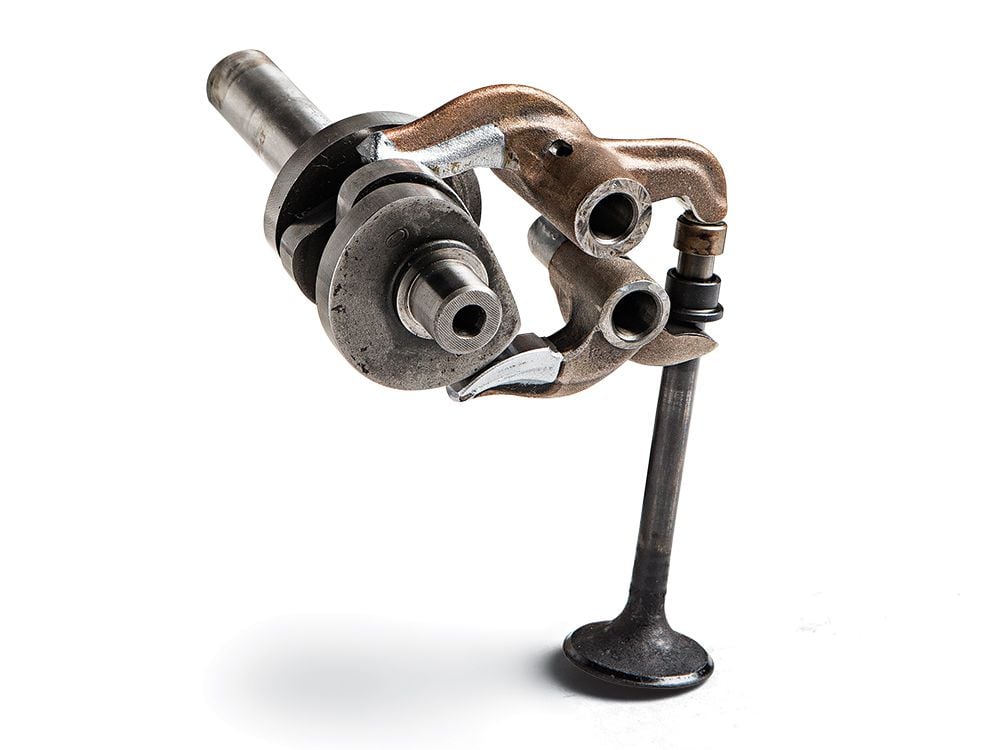






Hydraulic Valve Trains

TK4

Well-known member
Cars and Harleys have used hydraulic valve actuation for decades, Honda dabbled with it in the mid-80s then seemed to walk away.
It would seem a logical method of low maintenance valve clearance control but hasn't been adopted mainstream. Why ?
Inquiring minds need to know...
 
There are a few reasons..

1. Main reason is Rpm limits. Hydraulic lifters become sloppy above 5000 rpm, small high performance engines need tighter tolerances that hydraulic valves can't meet. That's why they're only found in cruisers.
2. Oil starvation can be an issue at high rpm, cold temps or at high lean angles, this can have catastrophic results for cams and valve trains.
3. Weight and space. They are heavy, require a bigger oil pump, a much larger cylinder head, and the engine needs to carry more oil to maintain a tighter oil temp window.
 
Hydraulic lash adjusters?

Adds weight, cost, and complexity. I think improved materials and manufacturing have largely removed the incentive for doing so. I just checked the clearances on my 2004 ZX10R after ignoring them for 60 000 km (155k on the bike) and only had to change one shim.
 
There are a few reasons..

1. Main reason is Rpm limits. Hydraulic lifters become sloppy above 5000 rpm, small high performance engines need tighter tolerances that hydraulic valves can't meet. That's why they're only found in cruisers.
2. Oil starvation can be an issue at high rpm, cold temps or at high lean angles, this can have catastrophic results for cams and valve trains.
3. Weight and space. They are heavy, require a bigger oil pump, a much larger cylinder head, and the engine needs to carry more oil to maintain a tighter oil temp window.
I'll buy that up to a point.
As an example, here are the specs for the twin cam, air/oil cooled 1984 Honda CB650SC Nighthawk.
Bulletproof design and shaft drive.
It, and its 550 and 750 brethren are still out there keeping it real.

Engine size655.0 ccm (39.97 cubic inches)
Type of engineIn-line four, four-stroke
Effect63.0 HP (46.0 kW))
Top speed175.0 km/h (108.7 mph)
Maximum RPM10,000
Compression9.5:1
 
I'm guessing that terrible Honda engine in the 00's that was half a fit (or half a civic?) engine had hydraulic lifters. It was the worst bike engine I have ever ridden. Just as it's starts making above zero power you bang into the rev limiter. It was hateful.amd I couldn't wait to get off.

I'm with Brian. Valve checks are a decent amount of work but assuming it isn't a high strung dirtbike, intervals are far apart and few adjustments are required.
 
I'm guessing that terrible Honda engine in the 00's that was half a fit (or half a civic?) engine had hydraulic lifters. It was the worst bike engine I have ever ridden. Just as it's starts making above zero power you bang into the rev limiter. It was hateful.amd I couldn't wait to get off.

I'm with Brian. Valve checks are a decent amount of work but assuming it isn't a high strung dirtbike, intervals are far apart and few adjustments are required.
I can't remember what that one was called, but it was like 'dreaded son of DN-01'.
Honda has thrown a lot of stuff at the wall and some of it didn't stick very well.
The problem was in the execution, not the concept. Oh wait, yes it was...
 
I'm guessing that terrible Honda engine in the 00's that was half a fit (or half a civic?) engine had hydraulic lifters. It was the worst bike engine I have ever ridden. Just as it's starts making above zero power you bang into the rev limiter. It was hateful.amd I couldn't wait to get off.

I'm with Brian. Valve checks are a decent amount of work but assuming it isn't a high strung dirtbike, intervals are far apart and few adjustments are required.
You're thinking of the NC750.

I agree with your assessment. It was awful. I test rode one at the Mosport Superbike Double-Header in the mid to late 2000's.l, or early 2010's.

Commuter bike POS. Like you said, as soon as it started making a tiny bit of power, SMACK... rev-limiter... at like 5,500 rpm or something abysmal.

Sent from my SM-S921W using Tapatalk
 
I'm a bit of a metalhead and prefer to Rock On!

AQKGIGWITAQCL6LWIMPC5NW46U.jpg


I'm waiting for pneumatic valves to hit the mainstream.

You've heard of V-TEC? Get ready for Pee-TEC! Urine for a revving good time!

[insert image of Pee-Strom here]
 
I'm a bit of a metalhead and prefer to Rock On!

AQKGIGWITAQCL6LWIMPC5NW46U.jpg


I'm waiting for pneumatic valves to hit the mainstream.

You've heard of V-TEC? Get ready for Pee-TEC! Urine for a revving good time!

[insert image of Pee-Strom here]
The Koenigsegg free valves are awesome. I like that guys moxy. Sadly, the entrance price is painful.
 
I'll buy that up to a point.
As an example, here are the specs for the twin cam, air/oil cooled 1984 Honda CB650SC Nighthawk.
Bulletproof design and shaft drive.
It, and its 550 and 750 brethren are still out there keeping it real.


Engine size655.0 ccm (39.97 cubic inches)
Type of engineIn-line four, four-stroke
Effect63.0 HP (46.0 kW))
Top speed175.0 km/h (108.7 mph)
Maximum RPM10,000
Compression9.5:1
The 650 Nighthawk does not have hydraulic lifters. Valves are adjusted with lock and screw.

The Nighthawk CB750 did use hydraulic lifters. It had a redline of 8500, and 75hp. The Honda CB 750F (10 years older without hydraulic lifters) redlined at 10200 rpm and packed 89hp.
 
Simple easy adjustment?
adjust
 
The 650 Nighthawk does not have hydraulic lifters. Valves are adjusted with lock and screw.

The Nighthawk CB750 did use hydraulic lifters. It had a redline of 8500, and 75hp. The Honda CB 750F (10 years older without hydraulic lifters) redlined at 10200 rpm and packed 89hp.
1984 and later CB550SC, CB650SC and CB750SC Nighthawks did indeed all briefly have hydraulic lifters. Look again.
A 1975 Honda CB750F made around 67hp with a redline of 8,000rpm. If you spun one up to 10,200 on a regular basis you'd be looking at positive crankcase ventilation.
 
Forget hydraulic, I want me some pneumatic valves!

(Then again, maybe not...)

1764769524017.jpeg
 
Back
Top Bottom